



Mystery of Muon Behavior in Ice Solved
- Quantum Effects Reveal the Key to a More Than 50-Year-Old Enigma -
High Energy Accelerator Research Organization (KEK)
J-PARC Center
Executuve Summary
Question
∗ The muon is an unstable elementary particle with a short lifetime of approximately two microseconds. During this brief window, it acts as a probe of its environment. When injected into liquid water, the muon attempts to sense the surrounding molecules through their magnetic fields; however, because these molecules move on timescales significantly shorter than a microsecond, the muon detects nothing. In contrast, when the water freezes, the muon instantly detects the magnetic fields of the water molecules, causing its spin orientation to undergo rapid relaxation. While this phenomenon has been observed since muon research started over five decades ago, no one had been able to accurately explain the underlying mechanism-nor had anyone realized that the key to this mystery lay in the system's quantum nature.
Findings
∗ Using a muon beam at J-PARC (Japan Proton Accelerator Research Complex), we observed 'quantum coherence'-a state in which quantum wave properties are preserved-in muon spins within ice. In this state, a muon replaces a hydrogen (proton) atom in a water molecule to form a unique molecule called MuOH. By modeling the magnetic field that the muon spin perceives from the surrounding nuclear spins of hydrogen atoms, we have successfully explained previously mysterious signal variations, including the spin depolarization caused by magnetic field fluctuations and the observed shifts in rotation frequency.
Meaning
∗ We have demonstrated the fundamental quantum effects in water-a ubiquitous substance in our world. As water serves as a foundational molecule across physics, chemistry, and biology, this discovery provides a new perspective that could impact a wide range of scientific fields.
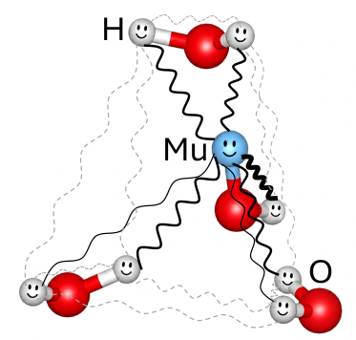 |
Figure 1: Conceptual illustration of the quantum behavior of muons in water. The blue sphere (muon) replaces a hydrogen atom in a water molecule to form "MuOH" molecule. Below freezing temperatures, the muon interacts with the surrounding water molecules (represented by wavy lines) through an invisible force. The thickness of the wavy lines indicates the strength of this interaction.
Summary
When muon is injected into ice, it replaces a hydrogen atom in a water molecule to form a unique molecule called MuOH. We discovered that the muon's spin within this molecule exhibits 'quantum coherence,' synchronizing its quantum waves with the nuclear spins of the surrounding hydrogen atoms. This phenomenon accounts for the long-standing mystery behind the signal variations observed below freezing point.
Overview
We have discovered a new quantum mechanism within ice. When muons are injected into water, they replace one of the hydrogen atoms in a water molecule (H2O) to form a unique species known as "MuOH". Our findings reveal that the muon spin within this molecule exhibits 'quantum coherence'-a state in which its quantum waves synchronize with the nuclear spins of surrounding hydrogen atoms. This interaction accounts for the signal variations observed in ice-based muon experiments, resolving a mystery that has persisted for decades.
Research Group
High Energy Accelerator Research Organization (KEK), Institute of Materials Structure Science: Amba Datt Pant (Researcher), Akihiro Koda (Professor), Katsuhiko Ishida (Researcher), Jumpei G. Nakamura (Engineer), Shoichiro Nishimura (Assistant Professor), Masatoshi Hiraishi (Researcher), Koichiro Shimomura (Professor) University of Göttingen, Germany: Burkhard Geil (Professor) Tribhuvan University, Nepal: Anjan Dahal (Researcher), Anup Shrestha (Researcher), Hari Shankar Mallik (Assistant Professor)
A Message from the Researcher
Amba Datt Pant, Researcher, KEK : After years of dedicated effort, our team has successfully uncovered a quantum effect in water, resolving a mystery that has persisted for over 50 years. This discovery marks a pivotal step in the use of muons to study hydrated materials and biological systems, paving the way for innovative applications in hypoxia imaging.
Research Background and Objectives
Muon beams act as a 'specialized microscope' for probing the microscopic properties of matter and life. They hold great promise for exploring biological phenomena-such as the functions of proteins and DNA-and for advancing medical applications. We are currently exploring the possibility of utilizing the high-intensity muon beam at J-PARC for cancer research (KAKENHI Grants 21K15583 and 26H01510). However, before we can achieve this, we must first establish a thorough understanding of what muons can reveal about the fundamental building blocks of life, such as water and amino acids. Although water is ubiquitous, it exhibits diverse characteristics depending on temperature and pressure. Despite over 50 years of research into the behavior of muons in water, the underlying microscopic mechanisms and their quantum nature have remained poorly understood. Therefore, we chose to begin our research with the most fundamental substance of all: water.
The Research Motivation
The turning point in our research occurred when we observed that a fraction of the muon signal from aqueous biological samples closely resembled that of pure water. This realization led us to prioritize a fundamental study of water itself before attempting to analyze more complex biological systems. We meticulously verified these results through repeated experiments and subsequently developed a model to explain the underlying quantum behavior.
Key Challenges We Overcame
The greatest challenge was re-envisioning this established field from a new perspective. We had to move beyond conventional thinking and adopt a rigorous quantum mechanical approach to truly understand how muon signals behave in both water and ice. Developing a theoretical model that incorporates these quantum interactions-and accurately explains our experimental data-was a significant hurdle that we successfully overcame through persistent effort.
What We have Discovered?
When a muon beam is injected into water, the charge state of the muons changes depending on whether the water is in a liquid or solid state. In liquid water, muons capture an electron to form "muonium" (a hydrogen atom analog where the proton is replaced by a muon), and muon bound to surrounding molecules (Figure 2). In ice, however, we have observed that the muonium structure is slightly distorted, and that unique "MuOH" molecule, as well as other distinct muon-related species.
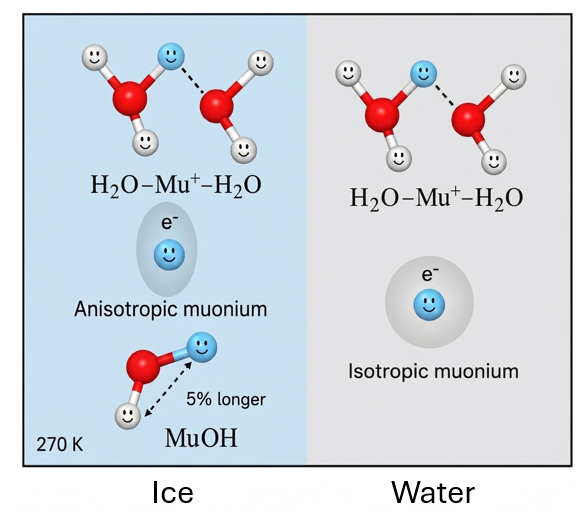
Figure 2: Schematic illustration showing the difference in muon states in water and ice, as observed in conventional experiments.
Signals (Figure 3) obtained by applying a magnetic field (20 G) to muons and measuring their spin evolution over time reveals a distinct difference between liquid water and ice. In liquid water, a coherent oscillation signal, analogous to the wobbling of a spinning top, persists for a long duration. In contrast, in ice, the oscillation decays rapidly (relaxation), accompanied by a slight shift in the oscillation period (frequency shift).
Despite over 50 years of research, these signal decays and frequency shifts in ice remained poorly understood. We proposed a model in which the muon spins within MuOH molecules 'interact quantum-mechanically' with the surrounding water molecules. Using this model, we successfully and consistently explained the experimental data without the need for ad-hoc mathematical adjustments. Furthermore, we confirmed the validity of this model through experiments with heavy water (D2O), leading to the discovery of a 'quantum effect' of muons in ice.
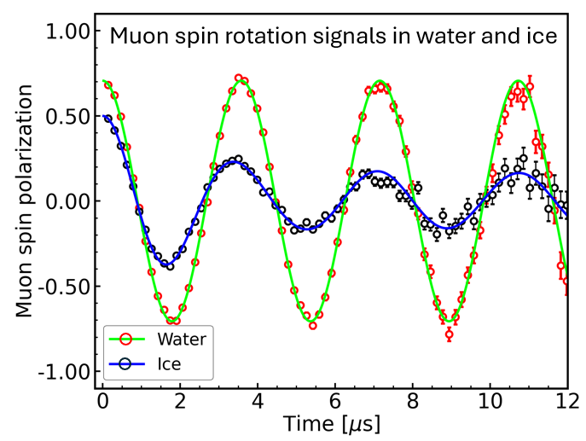 |
Figure 3: Muon spin rotation signals in liquid water (red circles) and ice (black circles). In liquid water, coherent oscillations persist, whereas in ice, the signal undergoes rapid decay (relaxation) and a frequency shift. This behavior is attributed to quantum-mechanical interactions of muon spins.
How Will This Change the Scientific World?
Water is essential for life on Earth. Gaining a deeper understanding of the microscopic quantum behavior within water is critical for advancing both biology and physics. This discovery unveils a fundamental scientific mechanism, offering new insights that are expected to drive innovation across a wide range of research fields.
 |
 |
Acknowledgments
The muon experiments were performed at the Materials and Life Science Experimental Facility of the J-PARC under a user program (Proposals 2022B0087, 2023B0217 and 2024A0304) at MLF, J-PARC. This work is supported by Grant-in-Aid for Scientific Research of the Ministry of Education, Culture, Sports, Science and Technology (MEXT), Japan, (KAKENHI Grant No. 21K15583). The spin-polarization function was developed with partial support from KAKENHI (Grant No. 22K05275).
Paper information
| Title | Origin of muon spin relaxation and frequency shift in frozen water explained by spin-dipole quantum coherences |
|---|---|
| Authors | Amba Datt Pant, Akihiro Koda, Burkhard Geil, Katsuhiko Ishida, Anjan Dahal, Anup Shrestha, Hari Shankar Mallik, Jumpei G. Nakamura, Shoichiro Nishimura, Masatoshi Hiraishi, and Koichiro Shimomura |
| Journal | Physical Review B (published online on July 7, 2026) |
| DOI | https://doi.org/10.1103/jvjm-bn2q |
| Other related recent papers | 1. Amba Datt Pant, Akihiro Koda, Burkhard Geil, Katsuhiko Ishida, Roshan Pudasaini, Kazuaki Kuwahata, Masanori Tachikawa, Stephen P. Cottrell, Jumpei G. Nakamura, Shoichiro Nishimura, and Koichiro Shimomura, Muon Species in Frozen D2O Observed with Zero-field Muon Spin Precession, Journal of the Physical Society of Japan 95,1 (2026) 014603.
2. Amba Datt Pant, Akihiro Koda, Burkhard Geil, Katsuhiko Ishida, Rajendra Adhikari, Kazuaki Kuwahata, Masanori Tachikawa, and Koichiro Shimomura, Formation and structure of MuOH in ice studied by muon spin rotation, Physical Review B 110, 10 (2024) 104104. |