



J-PARC News January 2026 (Issue#249)
■Japanese Society of Radiation Safety Management FY2024 Technical Award
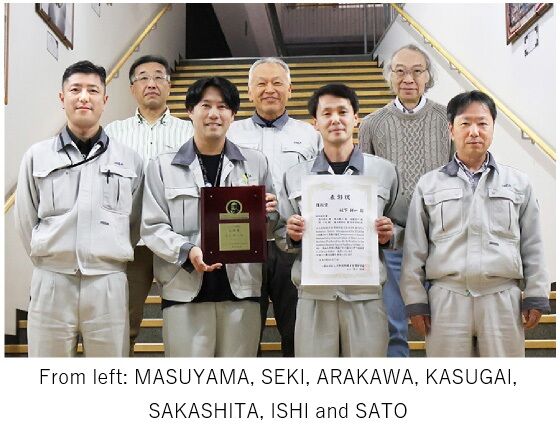
SAKASHITA Koichi, ARAKAWA Yuto, MASUYAMA Koichi, SATO Koichi, SEKI Kazunari, KASUGAI Yoshimi of the Safety Division, and ISHII Tetsuro of the Comprehensive Research Organization for Science and Society received the Japanese Society of Radiation Safety Management Technical Award.
During beam operation at the J-PARC Materials and Life Science Experimental Facility, the air in the hot cell is activated by neutrons. As a result, short-lived radionuclides such as 11C, 13N, and 15O are produced. Because these nuclides have the same decay mode, they are difficult to distinguish by measurement.
Under these conditions, the concentration of short-lived radionuclides was accurately evaluated by combining a simple measurement method using commercially available instruments with a simplified Monte Carlo-based model calculation.
Although this method is simple, it contributes to reliable radiation management. Its usefulness was highly recognized, leading to this award.
 |
■Press Release
(1) Pixel Count Increased 1,000 Times: Successful Imaging with 400 Million Pixels in the Superconducting State (December 18)
Superconducting detectors can detect very weak signals with high sensitivity and have therefore been widely used in various fields such as astronomy and medical science. In particular, research on their application to imaging has been actively pursued. However, increasing the number of pixels in imaging devices has been challenging. Major issues include cooling the entire device to extremely low temperatures, increasing the pixel count while maintaining pixel uniformity, and implementing signal multiplexing circuit technologies that allow multiple signals to be transmitted through a single line.
In this study, a new type of superconducting detector based on a novel principle, called the current-biased kinetic inductance detector (CB-KID), was developed. A readout circuit equipped with a high-resolution time-to-digital converter (TDC) with a time resolution of 30 picoseconds (10-12 seconds) was also developed. Using this system, imaging with 400 million pixels was successfully demonstrated.
By taking advantage of the high pixel count and the 30-picosecond time resolution, applications are expected across a wide range of fields, including astronomy, quantum information communication, life sciences, and medical science. Furthermore, as the system is equipped with a function that enables high-precision tracking over a dynamic range spanning 12 orders of magnitude-from 30 picoseconds to 30 seconds-it is expected to open the door to the development of new measurement and analysis methodologies.
For more details (Japanese only), please visit the J-PARC website.
https://j-parc.jp/c/press-release/2025/12/18001679.html
(2) Do Electron Spins Freeze When Cooled?
Discovery of Electron Spins Fluctuating Even at Low Temperatures Due to Ice-Like Disorder - Expected to Elucidate the Mechanism of Entangled Spin Fluctuations - (January 19)
When the temperature decreases, materials generally crystallize because atoms and molecules arrange themselves in an ordered structure. However, in ice, H₂O molecules can face many different directions, and changing their direction does not change the energy. As a result, even in the solid state, the orientations of molecules remain disordered.
A similar situation can occur in the quantum spins of electrons. To reduce their energy by relieving disorder, electron spins may form pairs and lose their magnetic properties, giving rise to an unusual state known as the random singlet state. This state has long been theoretically proposed and actively explored.
In this study, we investigated a spinel-type oxide containing magnesium and titanium using specific heat measurements, nuclear magnetic resonance (NMR), muon spin relaxation (μSR) experiments conducted with the general-purpose μSR spectrometer ARTEMIS at J-PARC MLF and at the Rutherford Appleton Laboratory in the United Kingdom, as well as neutron pair distribution function (PDF) analysis using the high-intensity total scattering instrument NOVA at MLF.
The results revealed that when the arrangement of titanium atoms exhibits ice-like disorder, a random singlet state emerges.
These findings indicate that even in materials with disorder in atomic positions and chemical species, electron spins can still form singlet states. A singlet state is characterized by quantum-entangled spins that fluctuate dynamically. Understanding the mechanism by which such states are stabilized may lead to applications in quantum technologies, including quantum computing. Furthermore, this finding deepens our fundamental understanding of why some materials freeze at low temperatures while others do not.
Crystal structure analysis of the samples in this study was carried out using the synchrotron radiation facility, Photon Factory (PF) at KEK. This research represents a collaborative achievement that integrates three of the four quantum beam facilities operated by the Institute of Materials Structure Science at KEK: neutrons, muons, and synchrotron radiation (in addition to low-energy positrons).
For more details (Japanese only), please visit the J-PARC website.
https://j-parc.jp/c/press-release/2026/01/19001714.html
■J-PARC Hello Science
Can the J-PARC Neutrino Beam Help Us Observe the Universe?! (December 19)
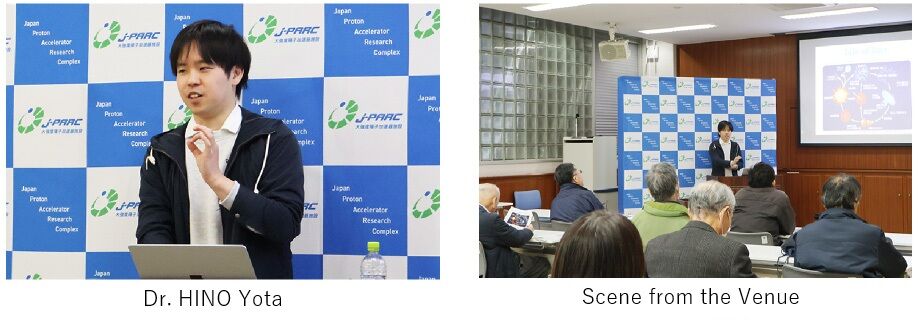
Dr. HINO Yota of the Particle and Nuclear Physics Division introduced his research on using accelerator-produced neutrinos to study the history of the universe.
When stars in the universe reach the end of their life cycle, they undergo a massive explosion known as a supernova, releasing intense light along with a huge number of neutrinos. Over the long history of the universe, countless stars have ended their lives in such explosions. The neutrinos produced in these events are called the Diffuse Supernova Neutrino Background (DSNB), and they are still filling the universe today. Observing the DSNB would provide important clues about when and how frequently stars were formed throughout cosmic history.
However, the neutrinos that reach Earth also include atmospheric neutrinos, which are naturally produced in the Earth's atmosphere. When these atmospheric neutrinos interact with oxygen atoms in water molecules, they cause reactions that closely resemble those produced by DSNB neutrinos. As a result, it is difficult to distinguish neutrinos originating from space from background signals.
This is where artificially produced neutrinos from the T2K experiment at J-PARC become useful. These neutrinos have energies similar to those of atmospheric neutrinos, and their properties are precisely known. By using such controlled neutrinos, researchers can study background noise in detail and remove unwanted signals.
In the ongoing SK-Gd experiment, data from the T2K experiment are being used to aim for the world's first observation of the DSNB. Improvements in the analysis of background events using artificial neutrinos are increasing the likelihood of detecting neutrinos emitted by stars in the distant past.
 |
J-PARC Outreach Lecture
(1) Nakamaru Elementary School, Tokai Village (December 16)
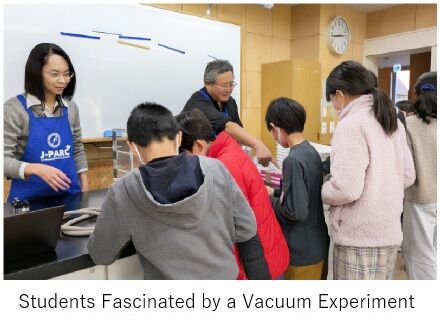
A special science class on the theme of "vacuum" was conducted by Ms. MOROHASHI Yuko of the Accelerator Division and Dr. UZUMAKI Tatsuya of the Public Relations Section for 4th- to 6th-grade students in the science club at Nakamaru Elementary School.
The students took part in a variety of experiments using a vacuum desiccator-such as observing what happens to balloons and marshmallows, or to hot water and carbonated water-and deepened their understanding of vacuum and atmospheric pressure in an enjoyable, hands-on way. They also learned that the accelerators at J-PARC operate under an extremely high-vacuum environment, comparable to the conditions at an altitude of about 40,000 kilometers, where many geostationary satellites orbit.
Finally, in the "vacuum cannon" demonstration, where students could experience the immense power of atmospheric pressure, loud pops accompanied the bursting of ping-pong balls and cans, prompting surprised reactions and excited cheers from the students.
 |
(2) National Institute of Technology, Kagawa College, Takuma Campus (December 18)
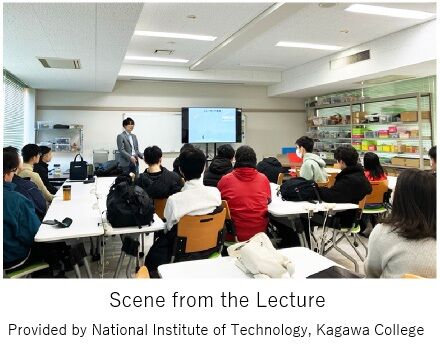
A special outreach lecture titled "How Accelerators Reveal the Microscopic World" was delivered by Dr. OTANI Masashi from the Accelerator Division at National Institute of Technology, Kagawa College, Takuma Campus.
Dr. OTANI explained the basic principles of accelerators and highlighted their broad applications in fields such as industry and medicine, along with recent technological developments. Participants shared comments such as, "I would like to learn how accelerators are built and how accelerators in Japan compare with those in other countries."
 |
(3) National Institute of Technology, Ibaraki College (December 24)
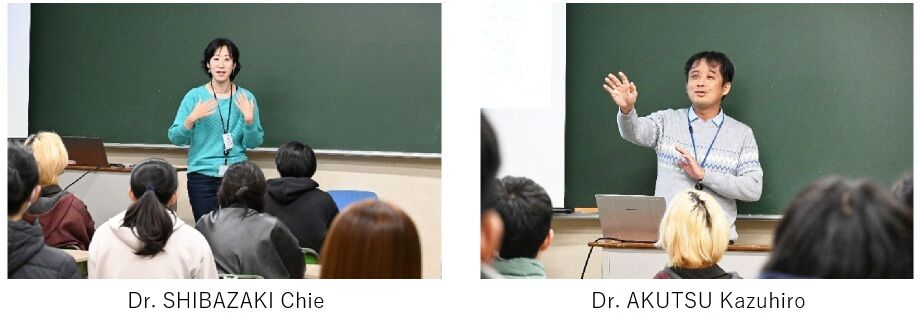
A J-PARC introduction seminar was held at the National Institute of Technology (KOSEN), Ibaraki College, for third-year students in the Department of Chemistry, Biology, and Environment. The speakers were Dr. SHIBAZAKI Chie of the Materials and Life Science Division and Dr. AKUTSU Kazuhiro of CROSS, and a total of 37 students participated.
First, Dr. AKUTSU presented an overview of J-PARC and emphasized the importance of science and technology. He also explained how researchers from diverse fields collaborate in research activities, and shared the appeal of working at a research facility, as well as the wide range of possible career paths, based on his own experience.
Dr. SHIBAZAKI then introduced her career path as a researcher and presented her ongoing protein research. She also highlighted that the facility is not only focused on physics but also actively carries out biological experiments.
During the Q&A session, students asked questions related to their future careers, such as "What is the pathway to becoming a researcher?" and "Are there qualifications that are useful for employment?" After the seminar, students expressed surprise at the nearby world-class facility and showed interest in the research topics and J-PARC as a workplace.
We hope that this seminar will serve as a valuable guide for students as they consider their future academic and career paths.
 |
■J-PARC Sanpo-michi 66: Susuki in Midwinter
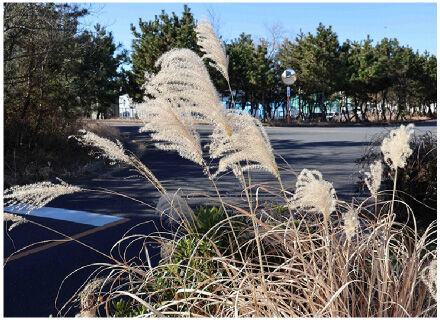
On January 23, the nearby city of Mito recorded a minimum temperature of −6.3℃. The photograph was taken on that day and shows a clump of susuki (Japanese pampas grass) growing in a narrow strip of soil between the parking lot and the road at the J-PARC Research Building.
The leaves have turned completely white and are hanging down, but the stems are still growing vigorously. At the tips of the stems, the plumes are surprisingly full. When observed up close, the plumes are covered with soft, cotton-like hairs and are densely packed with seeds.
Susuki is a perennial grass. In spring, reddish shoots emerge, and around the time of the Mid-Autumn Moon, the grass flowers and its plumes become most beautiful. Normally, the plants set seed in autumn, and the seeds are carried away by the wind. However, this season, some susuki plants have still not released their seeds, even at this time of year.
Susuki reproduces both through underground rhizomes and by seeds. Rhizomes help increase nearby plants, while seeds carry their genetic material over long distances. Having survived last year's long and hot summer, and now enduring the severe cold and strong winds of this day while still storing their seeds, what kind of survival strategy might these susuki plants be using?
 |