



Muon Acceleration: From Demonstration to Implementation
- Cooled muons accelerated to 0.3 MeV in the new dedicated experimental area -
J-PARC Center
High Energy Accelerator Research Organization (KEK)
Japan Atomic Energy Agency (JAEA)
The University of Tokyo
Tokai National Higher Education and Research System, Nagoya University
RIKEN
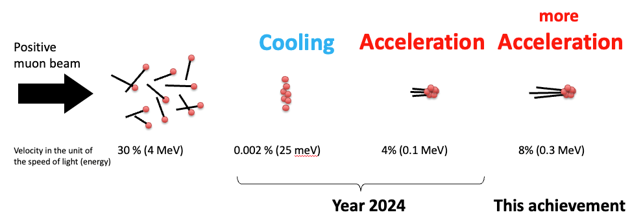 |
Figure 1: Conceptual diagram of positive muon cooling and acceleration. Cooling the positive muons, whose directions and velocities are initially spread out, enabled efficient radio-frequency acceleration.
At the Materials and Life Science Experimental Facility (MLF) of the Japan Proton Accelerator Research Complex (J-PARC, *1), muons were cooled from a kinetic energy of 4 MeV down to 25 meV (a reduction by a factor of about 160 million) and then accelerated to 0.3 MeV (approximately 8% of the speed of light) in the new experimental area dedicated to muon acceleration (Muon H2 Area, *2). Compared with the world's first demonstration of muon acceleration in 2024, this represents three times the energy and 200 times the intensity (approximately 10 muons per second). This achievement marks an important step toward the operation of the world's only muon accelerator.
Overview
The muon is an elementary particle similar to the electron. Muons produced artificially with accelerators are used in a wide range of fields, including materials science, particle physics, and the transmission imaging of large structures. However, ordinary muon beams produced at accelerator facilities have widely spread directions and velocities, and cannot be accelerated as they are.
A research group of KEK, the Japan Atomic Energy Agency, Okayama University, Nagoya University, Kyushu University, Ibaraki University, and Niigata University achieved the world's first demonstration of muon cooling ( *3) and acceleration, using a method in which muons are first cooled to a nearly-at-rest state and then accelerated with a radio-frequency accelerating cavity (press release of May 2024, "World's first cooling and acceleration of muon - The first muon accelerator finally coming to a reality -"). This result was featured on the cover of Physical Review Letters and was selected for the journal's 2025 collection of notable papers, receiving high international recognition.
This time, a research group of the J-PARC Center, KEK, the Japan Atomic Energy Agency, the University of Tokyo, Nagoya University, and RIKEN carried out a muon cooling and radio-frequency acceleration experiment in June 2026 in the experimental area (H2 Area) of the dedicated muon beamline (H-Line), newly constructed at MLF for the muon g-2/EDM experiment ( *4, *5), the transmission muon microscope, and the development of core technologies for artificial, transportable muon beams. As a result, muons were successfully accelerated to a kinetic energy of 0.3 MeV (approximately 8% of the speed of light). Compared with the 2024 demonstration (0.1 MeV, 0.05 muons per second), the group achieved three times the energy and 200 times the intensity (approximately 10 muons per second) in the area where the actual experiments will be performed.
Because this achievement was obtained in the area where the actual experiments will be performed, the research has advanced significantly from the "demonstration" stage of muon acceleration to the "implementation" stage of producing beams for actual experiments. It marks an important step toward the operation of the world's only muon accelerator. The group aims to achieve acceleration to 4 MeV (approximately 30% of the speed of light) around 2027-28, establishing the key technologies for future artificial, transportable muon beams. Ultimately, the muons will be accelerated to even higher energies (above 200 MeV, more than about 90% of the speed of light) for high-precision tests of the Standard Model of particle physics through precision measurements of the muon g-2 and EDM, as well as for applied research in materials science and engineering with the transmission muon microscope.
Research Group
Particle and Nuclear Physics Division, J-PARC Center
Materials and Life Science Division, J-PARC Center
Accelerator Division, J-PARC Center
Muon-Neutron Group, Institute of Particle and Nuclear Studies, KEK
Muon Science Section, Institute of Materials Structure Science, KEK
Accelerator Laboratory, KEK
Department of Physics, Graduate School of Science, The University of Tokyo
J-PARC Center, Japan Atomic Energy Agency
Kobayashi-Maskawa Institute for the Origin of Particles and the Universe, Nagoya University
Laboratory of High Energy Particle Physics, Department of Physics, Graduate School of Science, Nagoya University
RIKEN Center for Advanced Photonics
Background: From Demonstration to Implementation
The world's first demonstration of muon cooling and acceleration in 2024 was performed in a general-purpose experimental area (S2 Area) of the MLF muon facility. The actual muon g-2/EDM experiment, however, will be conducted in the experimental area (H2 Area) of the dedicated beamline (H-Line), which delivers one of the world's highest-intensity pulsed muon beams. The H2 Area was completed in Japanese fiscal year 2024 and began operation in fiscal year 2025.
The research group relocated the muon cooling apparatus (the cooled muon source) from the S2 Area to the H2 Area, and prepared and commissioned a newly built ultraviolet laser system that strips electrons efficiently, as well as the radio-frequency accelerating system for the cooled muons. In this experiment, these devices were combined to perform the entire sequence from muon cooling to acceleration for the first time in the actual experimental area.
What Did We Find?
The positive muon beam delivered to the H2 Area (approximately 30% of the speed of light, kinetic energy 4 MeV) was injected into a silica aerogel target to form muonium (a neutral atom consisting of a positive muon and an electron). By irradiating the muonium with a special ultraviolet laser (Figure 2) to strip the electrons, the group obtained positive muons cooled to a nearly-at-rest state (0.002% of the speed of light, kinetic energy 25 meV). These muons were then injected into the radio-frequency accelerating system and successfully accelerated to a kinetic energy of 0.3 MeV (approximately 8% of the speed of light) (Figure 3).
The data show that the intensity of the accelerated muons was approximately 10 muons per second, 200 times that of the 2024 demonstration (0.05 muons per second) (Figure 4). This is a major advance in both beam quality and intensity toward the realization of the world's first accelerated-muon facility.
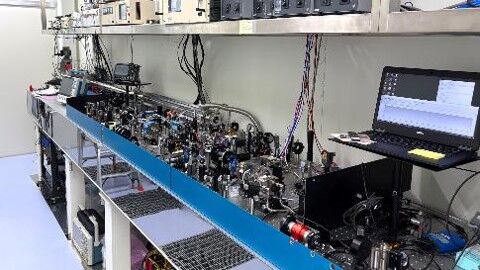
Figure 2: The newly built laser system, which can strip electrons efficiently.
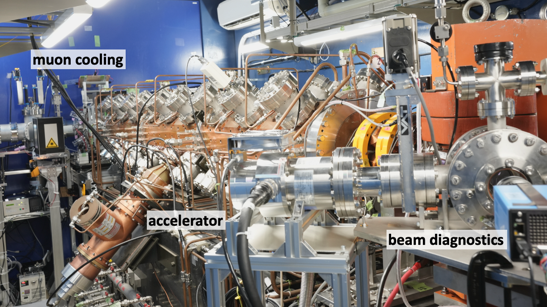
Figure 3: he apparatus installed in the H2 Area (from back to front: the muon cooling apparatus, the accelerating system, and the beam diagnostics).
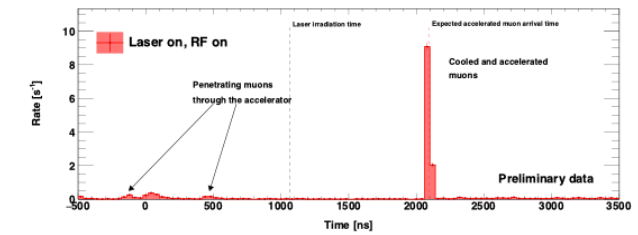
Figure 4: Signal of muons accelerated to 0.3 MeV, measured at the exit of the accelerating system.
How Will the World Change?
There are many accelerator facilities in the world, but no muon accelerator yet exists. With this achievement, the construction and commissioning toward the world's first muon accelerator have started in its dedicated experimental area. The group will successively connect accelerating cavities, further accelerating the muons from the 0.3 MeV achieved this time to reach 4 MeV (approximately 30% of the speed of light) around 2027-28, thereby establishing the fundamental technologies required for artificial, transportable muon generation. Ultimately, the group aims to use a highly directional muon beam accelerated to energies above 200 MeV for ultra-precise tests of possible cracks in the Standard Model of particle physics (the muon g-2/EDM experiment). Accelerated muon beams are also expected to find a wide range of applications, such as the transmission muon microscope, which can observe materials with nanometer resolution, and the transmission imaging of large structures.
Glossary
*1. Japan Proton Accelerator Research Complex (J-PARC)
A large-scale research facility jointly operated by the High Energy Accelerator Research Organization (KEK) and the Japan Atomic Energy Agency (JAEA) in Tokai Village, Ibaraki Prefecture, Japan. World-leading research is conducted there in a wide range of fields, from academic studies in particle physics, nuclear physics, condensed matter physics, chemistry, materials science, and biology to applied research for industry. At the Materials and Life Science Experimental Facility (MLF) in J-PARC, the world's highest-intensity muon and neutron beams are used by researchers from around the world.
*2. H-Line and H2 Area
A dedicated beamline (H-Line) newly constructed at the MLF muon facility to deliver one of the world's highest-intensity pulsed muon beams, and one of its experimental areas (H2 Area). The muon cooling apparatus and the linear accelerator are installed there.
*3. Muon cooling
Muon cooling means aligning the directions and velocities of muons. A muon beam is injected into silica aerogel to form muonium (a neutral atom consisting of a positive muon and an electron) in a nearly-at-rest state, after which an ultraviolet laser strips the electrons, leaving only positive muons.
*4. Anomalous magnetic moment (g-2)
The magnetic moment is one of the intrinsic properties of an elementary particle and is expressed as the product of a physical quantity called the Bohr magneton and a quantity called the g-factor. Quantum-mechanical effects appear as the deviation of the g-factor from 2, which is called the "anomalous magnetic moment" (g-2). It can be calculated with extremely high precision in the Standard Model.