



J-PARC News November 2025 (Issue#247)
■Topics
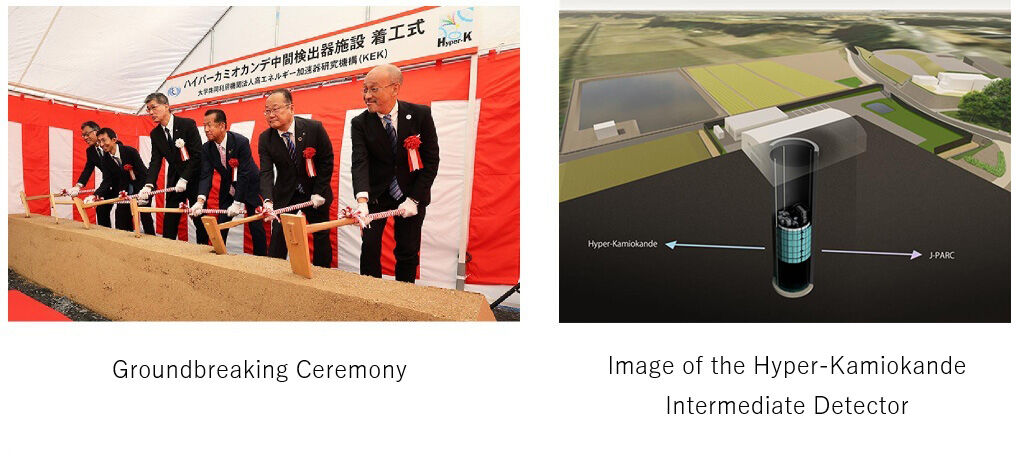
Groundbreaking Ceremony Held for the Hyper-Kamiokande Intermediate Detector Facility (November 4)
KEK (High Energy Accelerator Research Organization) held the groundbreaking ceremony for the construction of a new Intermediate Water Cherenkov Detector (IWCD) facility. Using this facility, neutrinos artificially generated from the J-PARC Neutrino Facility will be detected at a distance of approximately one kilometer. The observation by this detector in parallel with the existing near detectors installed inside J-PARC will enable us to measure neutrino oscillations-phenomena in which neutrinos change their type during flight-that are observed by the Hyper-Kamiokande experiment with higher precision than ever before.
KEK Director General Dr. ASAI Shoji stated, "By comparing measurements at Tokai using this detector with measurements at Kamioka using Hyper-Kamiokande, this detector is of such importance that measurements which would previously have required about ten years can now be achieved in around five years."
In 2028, Hyper-Kamiokande is scheduled to begin operation, and at J-PARC the proton beam power is planned to be increased from 750 kW to 1.3 MW to further increase the neutrino flux. In line with this schedule, the IWCD is also planned to begin observation in fiscal year 2028.
For more details, please visit the KEK website.
https://www.kek.jp/en/topics/202511111200iwcd
 |
■Award
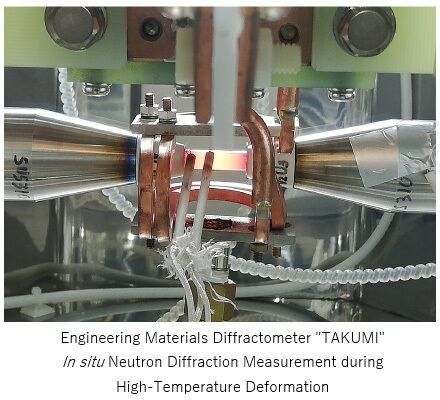
The Iron and Steel Institute of Japan - 2026 Sawamura Award
This award is given to papers that have made significant academic or technological contributions among those published in Tetsu-to-Hagane and ISIJ International in 2024.
It has been decided that the award will be presented to Dr. ZHANG Yongjie, Mr. MARUSAWA Kento, Mr. KUDO Kohei of the Institute for Materials Research, Tohoku University; Dr. MOROOKA Satoshi of the Materials Science Research Center, JAEA; Dr. HARJO Stefanus of the Materials and Life Division, J-PARC; Dr. MIYAMOTO Goro, Dr. FURUHARA Tadashi of the Institute for Materials Research, Tohoku University.
The awarded paper reports research carried out using the engineering materials diffractometer "TAKUMI" at J-PARC. By employing neutron diffraction, electron microscopy, and three-dimensional atom probe techniques, this study provides a comprehensive analysis of the low-temperature tempering processes in high-carbon martensitic steels, systematically elucidating carbide precipitation and lattice changes caused by carbon diffusion.
These research findings provide essential insights for ensuring toughness and ductility, and have greatly contributed to improving the understanding of tempering processes as well as the accuracy of steel performance predictions.
The award ceremony will be held on March 11, 2026.
 |
■Press Release
(1) "Rival" Neutrino Experiments NOvA and T2K Publish First Joint Analysis (October 23)
When the universe was born, matter (particles) and antimatter (antiparticles) are believed to have existed in equal amounts. However, almost all antimatter has disappeared, and only matter remains today. The reason for this imbalance is still unknown. Physicists expect that examining whether there are differences between neutrinos (particles) and antineutrinos (their antiparticles) may offer important clues to this mystery. In a joint analysis conducted by two different experimental groups, the T2K experiment in Japan and the NOvA experiment in the United States, the uncertainty in the neutrino mass-squared difference was successfully reduced to less than 2%. Although the experiments did not determine the mass ordering-that is, which of the three types of neutrinos is the lightest-they did find that depending on the ordering, the size of CP symmetry violation, a symmetry between particles and antiparticles, can be strongly constrained.
This collaborative analysis not only represents a significant step toward precision measurements of neutrino oscillations and understanding the origin of matter-antimatter asymmetry in the universe, but also demonstrates a complementary partnership between two groups that have often been seen as rivals.
For more details, please visit the J-PARC website.
https://www.j-parc.jp/c/en/press-release/2025/10/23001631.html
(2) Realization of a New Type of Magnetic Material Called a "p-Wave Magnetic Material" -Toward Efficient Magnetization Control Using Electric Current (October 23)
The phenomenon in which the energy of electrons changes with the direction of their spin is referred to as "spin splitting," and its symmetry allows it to be classified into s-wave, p-wave, and d-wave types. Among them, p-wave spin splitting, in which the sign of the spin splitting for electrons moving in opposite directions is reversed, has long been theoretically predicted; however, it has never been observed in a stable material, and no metallic p-wave magnetic material consistent with the lattice periodicity on an atomic scale has been reported to date.
In this study, the rare-earth intermetallic compound Gd3 (Ru, Rh) 4Al12 (Gd: gadolinium, Ru: ruthenium, Rh: rhodium, Al: aluminum) was focused on, and its magnetic structure was investigated in detail by employing resonant X-ray scattering together with the "SENJU" extreme-environment single-crystal neutron diffractometer and the "TAIKAN" small- and wide-angle neutron scattering instrument at the Materials and Life Science Experimental Facility (MLF), J-PARC. The results showed that this compound exhibits a coplanar helical magnetic structure in which all spins rotate within the same plane, thereby experimentally demonstrating the existence of a metallic p-wave magnetic material.
Furthermore, by fabricating microscale devices using a focused ion beam and measuring their properties, anisotropy in electrical resistance, as expected from the theory of p-wave spin splitting, was observed.
These results are expected to contribute to future applications in spintronics and quantum devices utilizing antiferromagnetic materials, in which electron spins alternately point in opposite directions.
For more details (Japanese only), please visit the J-PARC website.
https://j-parc.jp/c/press-release/2025/10/23001627.html
■J-PARC Hello Science
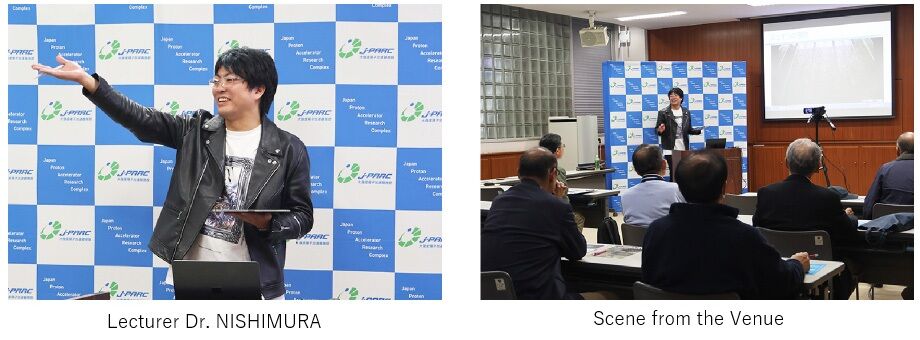
"In Love with Muons: Exploring Cosmic Mysteries through Ultimate Precision Measurements" (October 31)
The 99th J-PARC Hello Science lecture was given by Dr. NISHIMURA Shoichiro from the Materials and Life Science Division.
He explained that by advancing "precision measurements," we can verify whether the physical laws we have learned so far are truly correct. These measurements may also help us discover new laws that current theories cannot explain.
One of the key particles attracting attention for such precision measurements is the muon. Muons have a sufficiently long lifetime to be tracked experimentally, a heavier mass than electrons, and moderate interactions with other particles, making them relatively easy to handle for researchers. By studying the properties of muons in detail-one of the elementary particles that constitute the universe-we expect to obtain clues to various cosmic mysteries, including the origin of the universe, matter-antimatter symmetry, and the nature of dark matter.
Dr. NISHIMURA said, "Muon researchers simply love muons so much that they want to know everything about them." He also shared his hope to use the large number of muons produced at J-PARC to measure their mass, lifetime, and other properties as precisely as possible, and to take on the challenge of discovering new physics and solving mysteries of the universe.
 |
■J-PARC Outreach Lecture
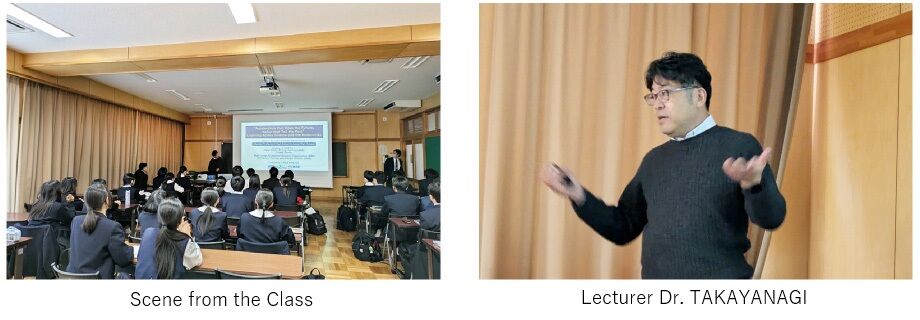
(1) Ibaraki High School and Junior High School (November 15)
A special outreach lecture titled "Accelerators Opening the Future, Kofun Revealing the Past - Learning through Humanities-Science Integration" was delivered by Dr. TAKAYANAGI Tomohiro from the Accelerator Division.
The lecture was held at Ibaraki High School, Dr. TAKAYANAGI's alma mater, as part of a special outreach program. Dr. TAKAYANAGI spoke passionately about J-PARC, the new interdisciplinary learning approach promoted through the Kofun Project in Tokai Village, and the value of contributing to one's local community.
The lecture took place after school in a voluntary attendance format, with 43 students-from second-year junior high school to second-year high school-gathering in the large conference room. Students asked highly insightful questions, such as, "Does the beam lose energy?" demonstrating a level of curiosity comparable to that of researchers.
At the end of the session, Dr. TAKAYANAGI left the students with an encouraging message: "Imagine yourself at forty and set your life goals. Think about what you should be doing now-what you should be doing today. The efforts you make today will shape your future."
 |
(2) National Institute of Technology, Kagawa College, Takamatsu Campus (November 17)
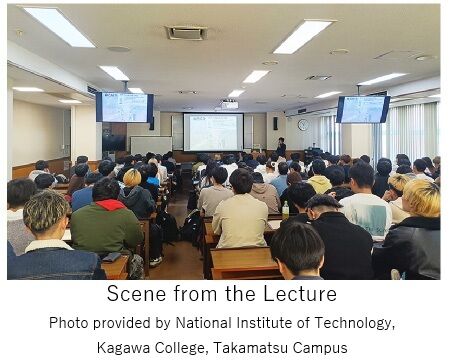
A special outreach lecture titled "How Accelerators Reveal the Microscopic World" was delivered by Dr. OTANI Masashi from the Accelerator Division at the Takamatsu Campus of the National Institute of Technology, Kagawa College, for fourth-year undergraduate students.
Dr. OTANI introduced the basic principles of accelerators, as well as a wide range of their applications in fields such as industry and medicine, along with recent technological developments.
Students shared comments such as, "I want to learn more about muons."
 |
■Muographic Investigation of Ancient Burial Mounds in Tokai: Installation of "Detector for History and Future No. 2" (November 16, Funatsuka No. 2 Burial Mound, Tokai Village)
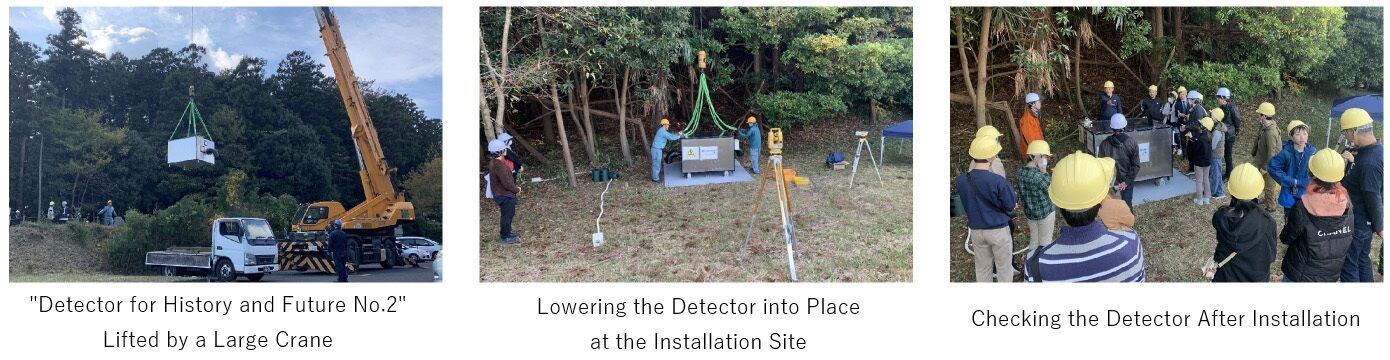
"Detector for History and Future No. 2" was installed at the site decided during the activity held last month.
On a calm autumn day, as 20 children and parents looked on, the detector was lifted high into the clear blue sky by a large crane and gently lowered into place.
This detector will be used together with "Detector for History and Future No. 1," which was installed last year, to measure cosmic-ray muons using a two-detector setup. With this system, it will become possible to create a three-dimensional image of the Funatsuka No. 2 Burial Mound, including any stone chamber (cavity) that may exist inside.
 |
■J-PARC Sanpo-michi 64: Warm and Cool Colors in Autumn
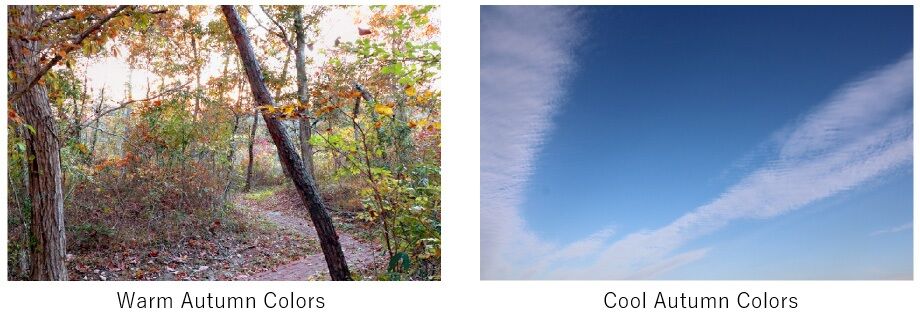
 The forest on the J-PARC site is covered with various kinds of trees. As soon as the unusually warm weather that had lasted until early October came to an end, the temperature dropped suddenly, and the autumn colors of the deciduous trees progressed all at once. Some of the early-turning trees have already lost their leaves, and gentle sunlight-now low in the sky-shines softly onto the ground scattered with acorns. Other trees still hold their red and yellow leaves, and the autumn forest is wrapped in the warmest colors of the year.
Meanwhile, when you look up, the clear blue sky seems to stretch endlessly into the distance. In the sky, distinct bands of fine white clouds appear, forming a clear pattern of wave clouds.
Wave clouds form at high altitudes, about 5 to 13 kilometers above the ground, and are one of the representative clouds of autumn. The autumn sky, filled with crisp, cool colors, seems to foreshadow the approach of winter.
 |