


J-PARC News May 2026 (Issue#253)
■Award
The 8th Achievement Award of the Materials Science and Technology Division, Atomic Energy Society of Japan
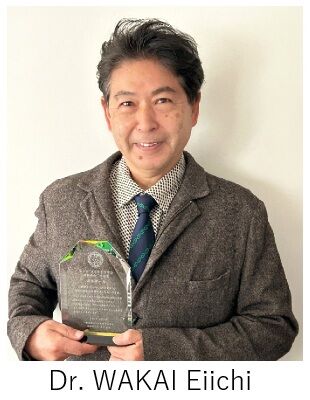
Dr. WAKAI Eiichi, a Research Fellow at the J-PARC Center, received the 8th Achievement Award of the Materials Science and Technology Division, Atomic Energy Society of Japan.
This award is presented to researchers who have made outstanding contributions and achievements in the field of nuclear materials science.
Dr. WAKAI led research activities as the first JAEA contact person for the J-PARC RaDIATE collaboration.
 |
■Press Release
(1) Transparent Bulk Amorphous Alumina Produced under High Pressure
- An Ultra-Dense Structure Composed of Five- and Six-Coordinated Aluminum and a Dielectric Constant Exceeding That of Crystalline Sapphire - (April 7)
Aluminum oxide (alumina) is widely used in industry because of its durability and chemical stability. Amorphous alumina, in which atoms are arranged irregularly, is used as a coating material for products such as cooking utensils. However, alumina has long been known as an oxide that is difficult to produce in the form of bulk glass.
In this study, researchers successfully produced transparent bulk alumina glass by applying high pressure to an alumina film at room temperature. The resulting material showed high thermal conductivity and hardness. Its dielectric constant was approximately 11.3, exceeding that of sapphire, a crystalline form of alumina, which has a dielectric constant of about 10.
Structural analysis using neutron diffraction at the High-Intensity Total Diffractometer NOVA of the Materials and Life Science Experimental Facility (MLF) at J-PARC revealed that distorted five-coordinated aluminum polyhedra (AlO5) were the dominant structural units. The study also found that high pressure produced dense six-coordinated octahedra (AlO6), a structure not normally observed in amorphous materials.
This study demonstrates a new approach to controlling material structures under high pressure to achieve enhanced properties. The method combines structural calculations and advanced structural analysis techniques, opening new possibilities for materials discovery and development. Further accumulation of knowledge using this approach is expected to lead to the discovery and development of innovative materials.
For more details (in Japanese only), please visit the J-PARC website.
https://j-parc.jp/c/press-release/2026/04/07001776.html
(2) World's First Direct Observation of Muonic Molecules Driving Muon-Catalyzed Fusion - High-Resolution X-ray Spectroscopy Confirms Theoretical Model Experimentally - (April 16)
Nuclear fusion, currently under development for practical applications, requires the control of plasma under extremely high-temperature and high-density conditions. In contrast, muon-catalyzed fusion (μCF) is a phenomenon that can occur at room temperature without the need for plasma. In μCF, a negatively charged muon replaces an electron and binds with hydrogen isotopes such as deuterium to form a "muonic molecule." This brings the hydrogen nuclei extremely close together, allowing nuclear fusion to occur. After the reaction, the muon can be reused repeatedly as a catalyst until it decays naturally, with an average lifetime of about two millionths of a second.
However, the formation process of muonic molecules, which is key to understanding μCF, has remained unclear for many years because theoretical predictions did not agree with experimental results.
In this study, the joint research group introduced a superconducting transition-edge sensor (TES) microcalorimeter, which provides more than ten times higher energy resolution than conventional silicon detectors. Using this detector, the researchers successfully observed weak X-rays emitted from the resonant states of muonic molecules, which had been difficult to detect directly. The observed results agreed with theoretical predictions that take these resonant states into account, resolving the long-standing discrepancy between theory and experiment. The findings are expected to contribute to a deeper understanding of μCF and support future efforts to improve its efficiency.
For more details (in Japanese only), please visit the J-PARC website.
https://j-parc.jp/c/press-release/2026/04/16001781.html
(3) Development of a Next-Generation Solid-State Refrigerant Operating over a Wide Temperature Range
- Discovery of an Elastocaloric Effect Beyond Conventional Theoretical Scaling - (April 30)
Conventional cooling technologies used in air conditioners and refrigerators rely on the expansion and compression of refrigerant gases. As a result, they face challenges such as high energy consumption and greenhouse gas emissions. In recent years, next-generation cooling technologies based on solid materials have attracted increasing attention.
In this study, the research group conducted compression tests on a Ti-Al-Cr superelastic alloy developed in 2025. The alloy exhibited superelastic behavior over an extremely wide temperature range from -196℃ to +187℃, returning almost to its original shape after the applied force was removed.
Using SENJU, the Special Environment Single-Crystal Neutron Diffractometer at the Materials and Life Science Experimental Facility (MLF) of J-PARC, the researchers directly observed changes in the crystal structure of the alloy under applied stress.
They also confirmed that the material exhibited an endothermic reaction (cooling effect) when the applied force was removed over a wide temperature range from -171℃ to +129℃. In particular, a remarkable temperature drop of approximately 10℃ was observed near room temperature, demonstrating its potential as a practical cooling material.
The thermal and elastic properties revealed in this study were observed over a much wider temperature range than predicted by conventional theories, providing a new design concept for elastocaloric materials. The material is also expected to have a wide range of applications, including thermal control systems for space technologies and other fields requiring temperature management over broad temperature ranges.
■J-PARC Hello Science
Power Electronics for Accelerator Magnet Systems (April 21)
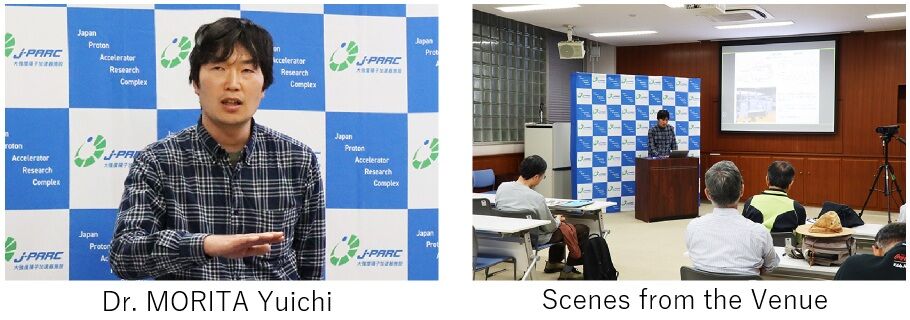
Dr. MORITA Yuichi from the Accelerator Division introduced efforts to improve the beam function of the Main Ring (MR), the largest accelerator at J-PARC.
In January 2026, the beam power of the MR reached 900 kW, far surpassing its original target of 750 kW. This increase in beam power was supported by newly developed magnet power supplies. To achieve a higher repetition rate by shortening the beam cycle and increasing the acceleration frequency, the entire system was reviewed and upgraded, including the development of a new capacitor bank and the reconfiguration of existing power supplies. Rather than outsourcing the work entirely to manufacturers, J-PARC staff played a central role in these developments. By directly participating in the development and improvement of the equipment, researchers and engineers have been able to perform adjustments and maintenance more flexibly and efficiently. These efforts have contributed not only to improved performance but also to cost reduction.
Currently, further upgrades are underway in preparation for the Hyper-Kamiokande project, which is scheduled to begin operation in FY2028. Efforts are being made to shorten the beam cycle from 1.28 seconds to 1.16 seconds and ultimately increase the beam power to 1.3 MW. These improvements are expected to lead to new scientific achievements.
 |
■J-PARC Outreach Lecture
National Institute of Technology, Akita College (May 8)
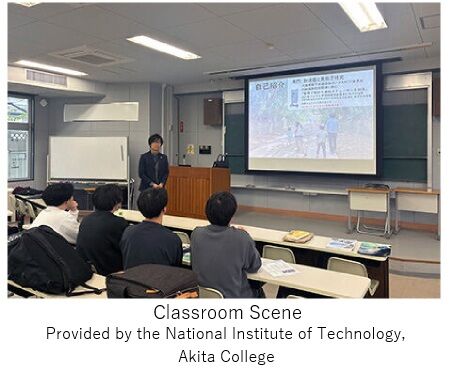
Dr. OTANI Masashi of the Accelerator Division delivered a lecture titled "How Accelerators Reveal the Microscopic World: Muon Acceleration Technology for Probing from Particle Phenomena to Massive Structures" at the National Institute of Technology, Akita College.
During the lecture, Dr. OTANI explained the principles of particle accelerators and their applications, including medical uses. He also presented recent technological developments and research involving muons, his area of expertise, as well as particle physics research using muon acceleration technology.
In addition, he introduced an ongoing human resource development program for accelerator engineers through the construction of compact accelerators in collaboration with National Institute of Technology colleges, mainly the National Institute of Technology, Oyama College.
In a questionnaire conducted after the lecture, students shared comments on the research topics, such as "I thought the research using muons to investigate dark matter sounded interesting." Others also expressed interest in actually building accelerators, saying, "I would like to learn more about the accelerators being developed at National Institute of Technology colleges," and "I would like to know more about how to make electromagnets because I want to try building one myself."
 |
■KEK Exhibits at Nico Nico Chokaigi 2026 (April 25-26)
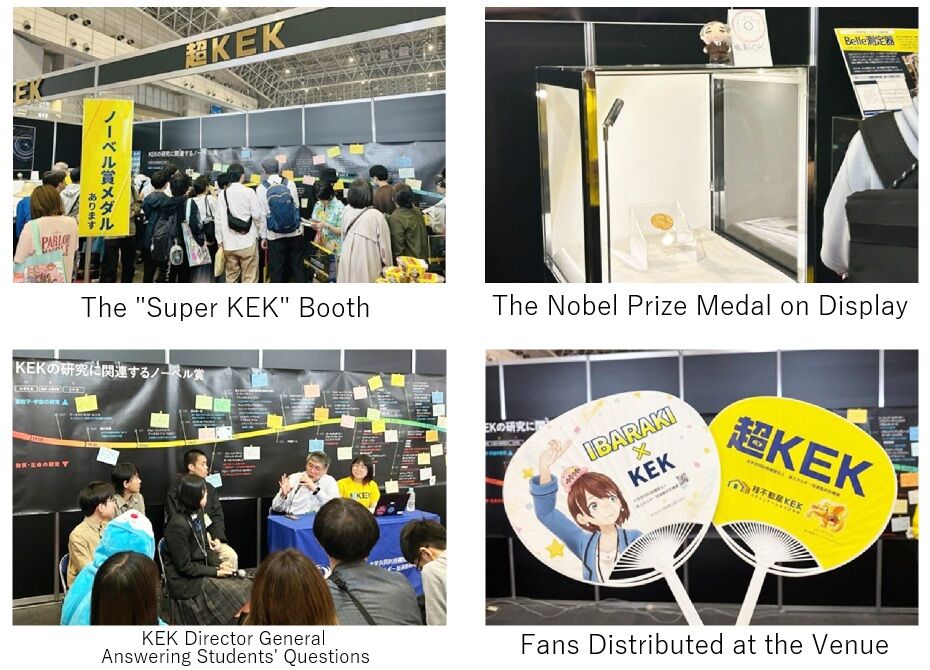
KEK exhibited a booth titled "Super KEK" at Nico Nico Chokaigi 2026, held at Makuhari Messe in Chiba Prefecture. Nico Nico Chokaigi is a unique festival that brings together online and real-world communities and is centered around users of Nico Nico, one of Japan's largest video-sharing services operated by DWANGO Co., Ltd. This year's event attracted 138,228 visitors.
For its fourth participation in the event, KEK adopted "Nobel Prizes" as the theme of its exhibit. Highlights included an official replica of the Nobel Prize medal awarded to Prof. KOBAYASHI Makoto, KEK Distinguished Professor Emeritus, who received the Nobel Prize in Physics in 2008, as well as a timeline introducing Nobel Prize-winning research directly or indirectly connected to KEK. The booth also featured the Silicon Vertex Detector (SVD), which contributed to Nobel Prize-winning research in physics. Researchers at the booth explained accelerators and particle detectors to visitors.
In addition, a talk session was held featuring KEK Director General Dr. ASAI and members of the N High School Group Research Department. They discussed cutting-edge research being conducted at KEK and various approaches to scientific research activities.
The booth also featured an SNS campaign, a lottery linked to a Nobel Prize-themed quiz, and the distribution of special fans created in collaboration with Ibaraki Prefecture. The event provided an excellent opportunity for visitors to learn more about KEK and J-PARC.
 |
■Announcement
Announcement of the "J-PARC and Nuclear Science Research Institute Open House 2026"
J-PARC and the Nuclear Science Research Institute will jointly host the "J-PARC and Nuclear Science Research Institute Open House 2026" on Sunday, September 13, from 9:30 a.m. to 4:00 p.m., under the theme of "See, Hear, and Experience Cutting-Edge Science!" Visitors will have the opportunity to tour accelerator and experimental facilities that are not normally accessible to the public.
A variety of activities will also be joined, including science cafes, hands-on science workshops, and food trucks, making the event enjoyable for both children and adults.
Admission is free and no reservation is required.* We look forward to welcoming you!
*Reservations will be required for some facilities.
 |
■J-PARC Sanpo-michi 70: - J-PARC Shrouded in Sea Fog -
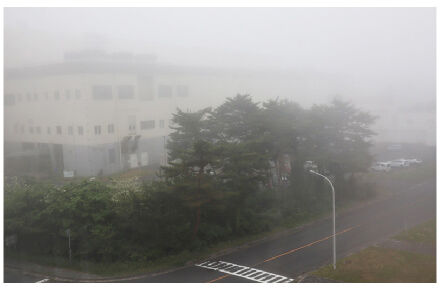
The photograph shows the MLF building as seen from the J-PARC Research Center building on May 8, when the fresh greenery of spring had become increasingly vibrant.
Although the building is only a few dozen meters away, it is almost completely hidden by dense sea fog. The day was unusually cool for May, and walking through the fog created a sense of calm tension.
Sea fog frequently occurs along the coast of Ibaraki from spring to early summer. Warm air is rapidly cooled when it comes into contact with the cold sea surface, causing excess moisture in the air to condense into fog. While sea fog creates beautiful and mysterious scenery, it can also disrupt transportation, including ship navigation, and may even cause agricultural damage due to reduced sunlight.
Sea fog contains a large amount of salt. The fog can penetrate buildings and accelerate corrosion of facilities and piping. For this reason, careful inspections for rust are carried out daily, and any problems found must be addressed promptly. The safe and stable operation of J-PARC, located close to the coast, is supported by these steady maintenance efforts.
 |