


J-PARC News June 2026 (Issue#254)
■Award
The 16th Materia Japan Award for Science and Technology
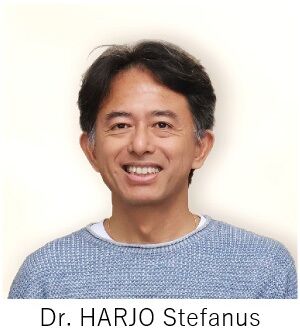
A paper co-authored by Dr. HARJO Stefanus of the Materials and Life Science Division (first author: Prof. YAMASAKI Michiaki, Kumamoto University) received the 16th Materia Japan Award for Science and Technology.
This award is presented to outstanding papers published in Materia, the bulletin of the Japan Institute of Metals and Materials, that have made significant academic or scientific and technological contributions to the advancement of metals and related materials.
The award-winning paper, "Design of Wrought Light Metals with Both High Strength and High Ductility through Functional Multimodal Control," was published in the January 2024 issue of Materia. The paper elucidates the mechanisms responsible for the exceptional combination of high strength and high ductility in wrought magnesium alloys, based on an understanding of nanoscale dynamic behavior.
 |
■Press Release
Possible Presence of Large Amounts of Hydrogen in Earth's Outer Core
- First Direct Determination of Hydrogen Content in Liquid Iron by In-Situ Observation - (May 13)
The Earth's core, which is composed mainly of iron, is known to have a lower density than pure iron under the high-pressure and high-temperature conditions found there. This lower density is thought to be caused by the presence of light elements mixed within the core, with hydrogen considered a leading candidate. This is because hydrogen is the most abundant element in the universe and dissolves easily into iron under high-pressure conditions.
However, there had been no way to observe hydrogen in liquid iron under such extreme conditions, so the amount of the hydrogen that could be dissolved has remained unknown.
In this study, researchers observed hydrogen-bearing liquid iron (FeHx) under conditions of 1,127℃ and 34,000 atmospheres via neutron imaging at the high-pressure neutron diffractometer PLANET at the Materials and Life Science Experimental Facility (MLF) of J-PARC, and succeed in directly determining the hydrogen content in liquid iron for the first time in the world.
The results revealed that liquid iron can dissolve hydrogen at a concentration of 0.17 wt%. This suggests that outer core can contain 70 to 85 times the amount of hydrogen (H) currently present in oceans, and that the dissolution of hydrogen could account for more than half of the density deficit of the Earth's outer core.
This study provides the constraint on hydrogen content of the Earth's outer core through direct measurement for the first time. The findings have implications for a wide range of fields, including our understanding of hydrogen circulation inside the Earth and the core formation processes of other planets. Moving forward, we are interested in determining the hydrogen content under higher pressures and in investigating differences in solubility when hydrogen coexists with other light elements.
For more details, click here (J-PARC website)
https://j-parc.jp/c/press-release/2026/05/13001802.html
■J-PARC Safety Day (May 22)
On May 23, 2013, a radioactive material leak incident occurred at the Hadron Experimental Facility at J-PARC, causing significant concern and inconvenience to local residents and many others. Every year around this date, J-PARC holds J-PARC Safety Day as an opportunity to reflect on the importance of safety.
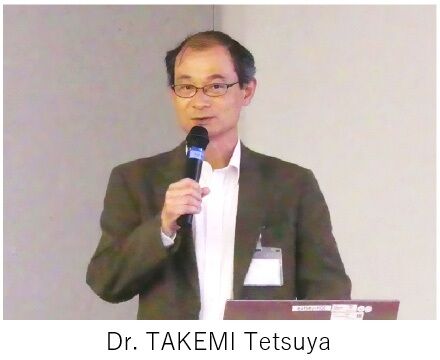
The event was held for the 13th time this year in a hybrid format, with 379 participants. During the morning session, as the Safety Information Exchange Meeting, each section introduced initiatives and case studies related to radiation safety. In the afternoon the Workshop for Fostering Safety Culture, the J-PARC Safety Awards were presented. The Hadron Section received the Award for the Most Safety Best Practices, while three J-PARC staff members were honored with the Safety Contribution Award for their long-standing commitment to safety at J-PARC. This was followed by a lecture titled "Mechanisms Behind Extreme Weather Events Such as Heavy Rainfall and Tornadoes, and How to Prepare for Them," presented by Prof. TAKEMI Tetsuya of the Disaster Prevention Research Institute, Kyoto University. He explained the mechanisms and recent characteristics of extreme weather events—including heavy rainfall, tornadoes, typhoons, and lightning—from both global and local perspectives. He also emphasized that disaster risks continue to change as land use evolves through urban redevelopment and other factors, highlighting the importance of continuously reviewing and updating disaster preparedness rather than assuming that past experience guarantees future safety. The event concluded with a screening of a documentary on the J-PARC Radioactive Material Leak Incident, reaffirming the participants' commitment to preserving the lessons learned from the accident.
J-PARC will continue to hold this event annually and remain committed to placing the highest priority on safety in all research activities to ensure that such an accident never occurs again.
 |
■J-PARC Hello Science
Beams and the Theory of Relativity (May 29)
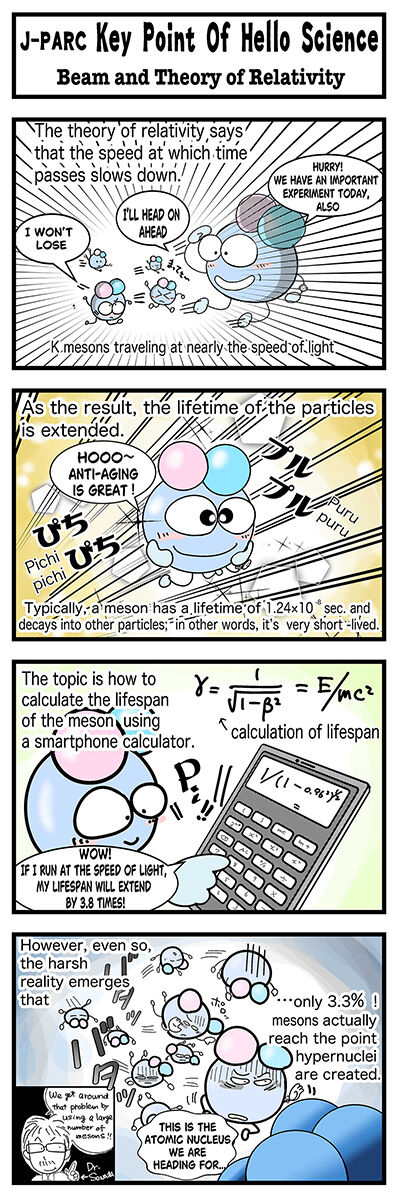
The content of Hello Science is presented in a four-panel comic.
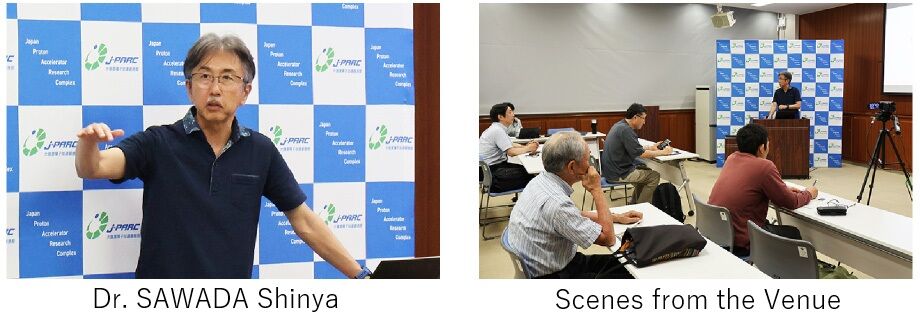
In the May session of Hello Science, Dr. SAWADA Shinya of the Particle and Nuclear Physics Division explained how Einstein's theory of relativity is indispensable to research at J-PARC.
At J-PARC, researchers use proton beams accelerated to nearly the speed of light, as well as the secondary particle beams they produce, to investigate the fundamental structure of atomic nuclei and matter. The theory of relativity plays a particularly important role in experiments involving unstable secondary particles with finite lifetimes.
During the session, participants used the calculator app on their smartphones or scientific calculators to calculate how the theory of relativity is applied in experiments at J-PARC.
Concepts that often seem difficult to understand became much more accessible as the calculations produced concrete numerical results on their screens, helping participants gain a deeper understanding of both the theory of relativity and J-PARC research.
Previous Hello Science videos are also available on the J-PARC YouTube channel!
https://youtube.com/playlist?list=PLoJacoLqZ0cXiowgQmKybiPLv9rkPTa0h&si=s9-44k_eLdrLOdMR
 |
■J-PARC Outreach Lecture
(1) Kanrin Japanese School, Aoba Ward, Yokohama City (May 27)
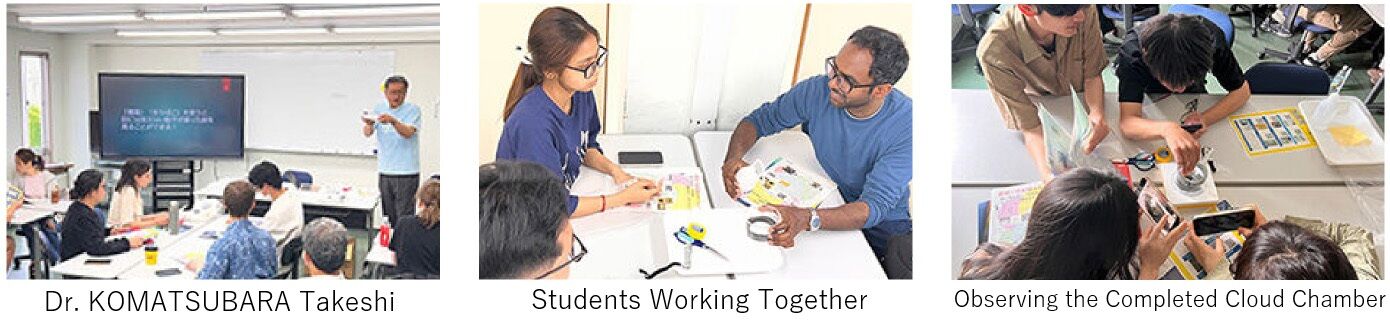
Dr. KOMATSUBARA Takeshi from the J-PARC Center delivered a science experiment workshop at Kanrin Japanese School on the theme of a cloud chamber.
Second-year students participated in the workshop and built cloud chambers in groups. The students were fascinated as they carefully observed the fleeting tracks left by invisible particles.
Each time a white track appeared in the cloud chamber, excited voices could be heard in the classroom. The workshop not only helped the students deepen their understanding of the research conducted at J-PARC, but also provided a valuable opportunity to broaden their learning. Many students were seen actively communicating in Japanese while working together in groups.
 |
(2) Narusawa Elementary School, Hitachi City (June 2)
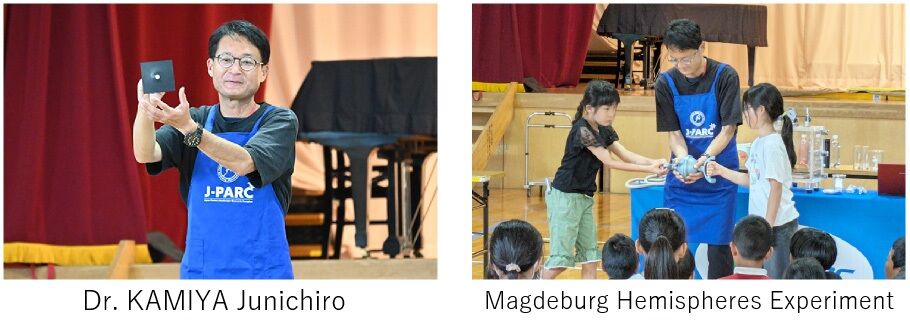
Dr. KAMIYA Junichiro of the Accelerators Division delivered a lecture and experimental workshop titled "Let's Explore the Invisible World of Vacuum" at Narusawa Elementary School in Hitachi City.
Twenty-six fourth-grade students learned what happens to objects such as marshmallows and balloons in a vacuum through a series of experiments. The students watched with great interest as the marshmallows and balloons expanded when placed in a vacuum.
They also took part in various experiments, including the Magdeburg hemispheres experiment and an experiment demonstrating what happens to a feather and a coin when they fall inside a transparent vacuum tube.
Finally, through a vacuum cannon experiment, Dr. KAMIYA explained that vacuum plays an important role in accelerating particles at J-PARC.
 |
(3) Hakuoh University Ashikaga Junior High School, Tochigi Prefecture (June 6)
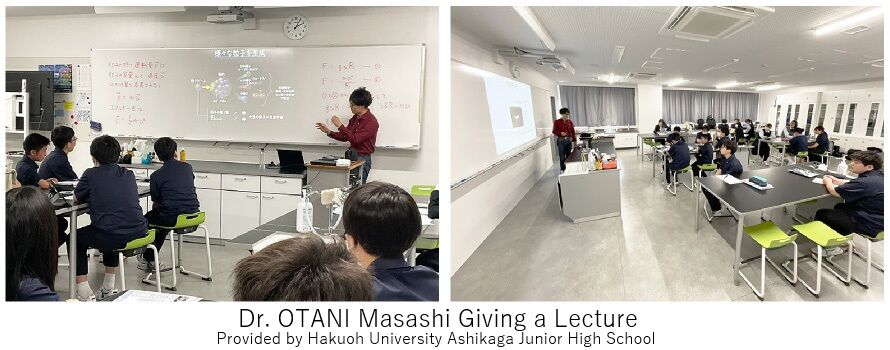
Dr. OTANI Masashi of the Accelerators Division delivered a lecture titled “How Accelerators Reveal the Microscopic World: Muon Acceleration Technology for Probing from Particle Phenomena to Massive Structures” at Hakuoh University Ashikaga Junior High School.
In the lecture, Dr. OTANI explained the principles of particle accelerators and their applications, including medical uses. He also introduced the properties of muons, methods of muon acceleration, and recent technological developments and research in particle physics using muon acceleration technology.
In addition, he presented an ongoing human resource development program for accelerator engineers through the construction of compact accelerators in collaboration with the National Institute of Technology (KOSEN).
According to the post-lecture questionnaire, students showed a strong interest in accelerator technology. Some commented that they would like to learn more about methods for controlling high voltages in multi-stage acceleration systems.
 |
■Muographic Investigation of Ancient Burial Mounds in Tokai: Artifact Handling and Excavation Workshop (Tokai Village Museum, May 31)
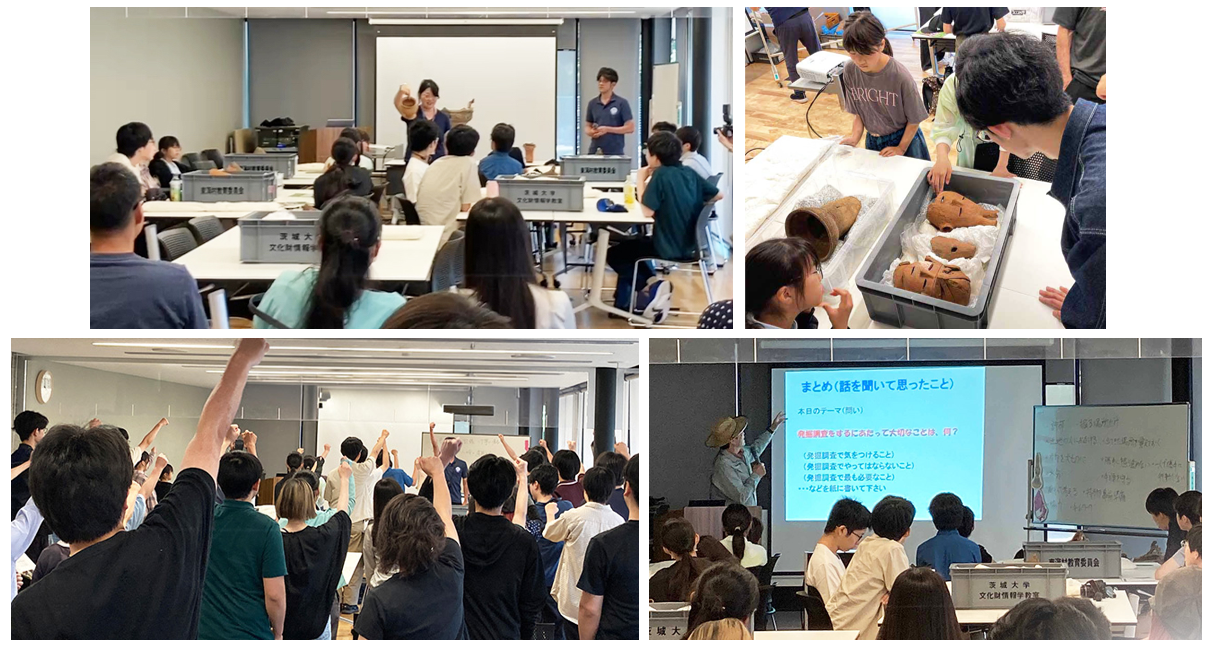
The first activity of FY2026 was held on May 31. This project is now in its fourth year, and excavation of the surrounding moat will begin this year. In preparation for the excavation, museum curators Mr. NAKAIZUMI and Ms. HAYASHI gave a lecture on how to handle excavated artifacts, followed by an excavation workshop by Prof. TANAKA of Ibaraki University.
First, Mr. NAKAIZUMI and Ms. HAYASHI explained how to handle excavated artifacts. Ms. HAYASHI intentionally handled a replica pottery piece incorrectly by using one hand and wearing a wristwatch. The children were asked to find what was wrong and think about what should not be done during an actual excavation.
Next, participants observed real Jomon pottery and haniwa. After looking at the differences in their shapes and colors, they carefully touched the artifacts. They then practiced lifting them out of the box and placing them gently on the table. Everyone handled the artifacts carefully while remembering what they had learned.
In the second half of the program, Prof. TANAKA of Ibaraki University gave a talk titled "Archaeological Excavation Means Unearthing Everyone's Treasure." Participants learned about the importance of archaeological excavation and discussed what should be kept in mind during excavation work. The event ended with everyone chanting, "Muon ni Kofun!"
 |
■J-PARC Sanpo-michi 71: - J-PARC Director Gives an Outreach Lecture at a Refreshing Highland Resort -
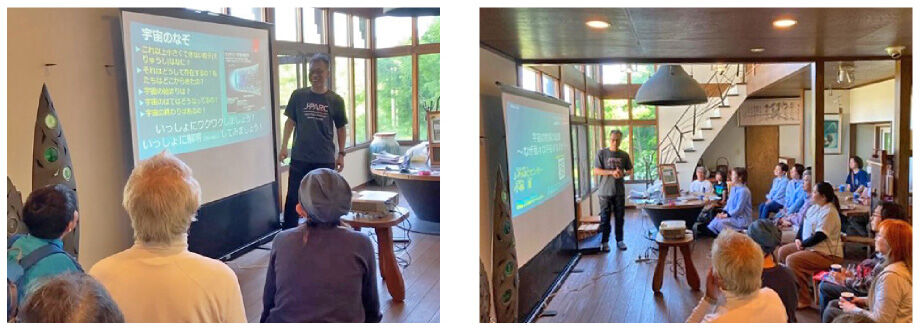
Urabandai in Fukushima Prefecture is one of Japan's leading resort areas, surrounded by volcanoes, forests, and lakes. J-PARC Director General Kobayashi, an enthusiastic sports lover, has visited the area dozens of times for skiing and hiking and has many friends in the local community. At their request, he gave an outreach lecture on May 30 at Sasakitei, a local bakery and cafe.
J-PARC frequently offers outreach lectures at schools, science museums, and similar venues, but this was the first time such an event had been held at a highland resort. Although there were initial concerns about attendance, the venue was filled to capacity on the day of the event.
The lecture took place in the spacious rear section of a log cabin-style building with a high ceiling. When the large windows were opened, a refreshing breeze flowed through the fresh green trees. In this warm and relaxed atmosphere, participants settled into their seats and listened with great interest to talks about the mysteries of the universe, the unique features of J-PARC, and its latest research achievements.
Located at an elevation of about 800 meters and far from any large cities, Urabandai offers excellent conditions for stargazing. Following the lecture, participants suggested holding a future event that would combine stargazing through telescopes with presentations on cutting-edge research, including neutrinos, to explore the mysteries of the universe. They also expressed interest in making these outreach lectures a regular series.
 |