


J-PARC News September 2026 (Issue#257)
■J-PARC and Nuclear Science Research Institute Open House 2026
- See, Hear, and Experience Cutting-Edge Science! (September 13)
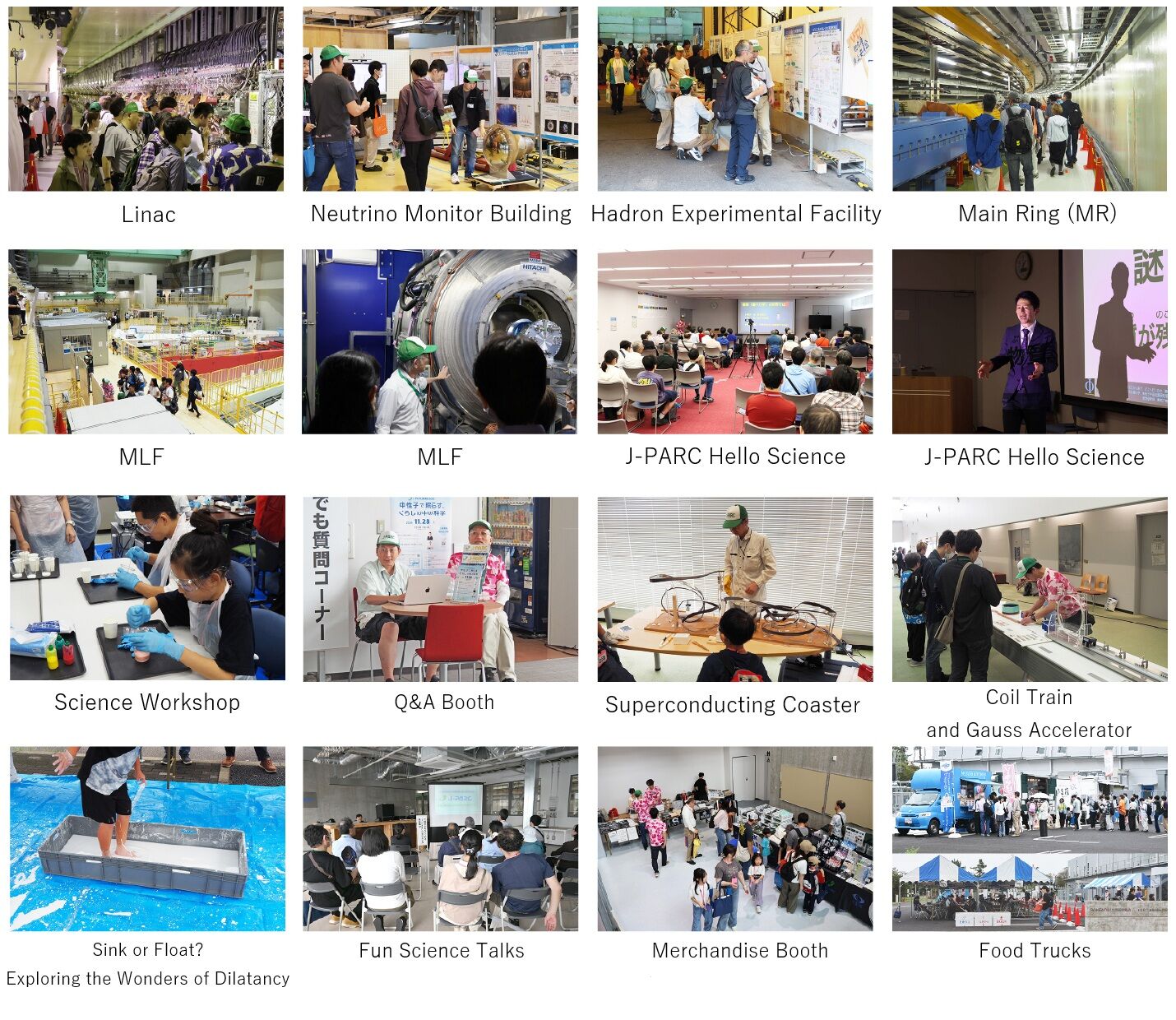
As in the previous year, J-PARC and the Nuclear Science Research Institute held a joint open house event. Although there was occasional drizzle throughout the day, the event attracted 2,006 visitors to the two facilities, a significant increase from 1,646 visitors last year.
At J-PARC, accelerator and experimental facilities were opened to the public, along with exhibitions, hands-on activities, and craft workshops. Five lectures were also held as part of the "J-PARC Hello Science" program.
Thank you to everyone who visited us. We look forward to seeing you again next year.
 |
■Award
The 22nd Particle Accelerator Society of Japan Awards (August 26-28, Sendai International Center)
(1) The 22nd PASJ Award for Technological Contribution
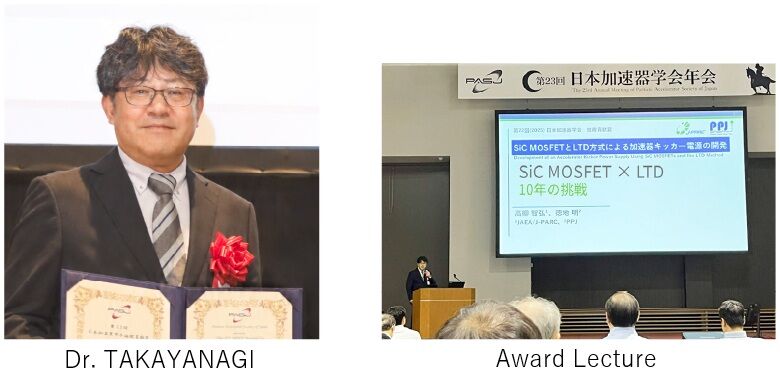
Dr. TAKAYANAGI Tomohiro of Accelerator Division II received the 22nd PASJ Award for Technological Contribution.
Dr. TAKAYANAGI developed a new solid-state power supply for the beam extraction kicker magnet of the J-PARC RCS. The power supply combines SiC MOSFETs, next-generation power semiconductor devices, with a linear transformer driver (LTD) system that can generate high-current and high-voltage pulses at high speed.
The new power supply achieves a fast rise time comparable to that of the conventional thyratron system. It also keeps the magnetic field waveform flatness within ±0.2%, meeting the requirements of the RCS. In addition, the new system does not require an external pulse forming network (PFN), which was used to generate high-voltage pulses. This reduces the required output voltage by half. The system also reduces the equipment volume by approximately 80% and power consumption by approximately 25%. The cooling system was also changed from water cooling to air cooling, so a dedicated cooling water system is no longer needed at the facility.
These achievements were highly regarded for their contribution to improving the reliability, energy efficiency, and ease of maintenance of the kicker power supply.
 |
(2) The 22nd PASJ Award for Distinguished Services
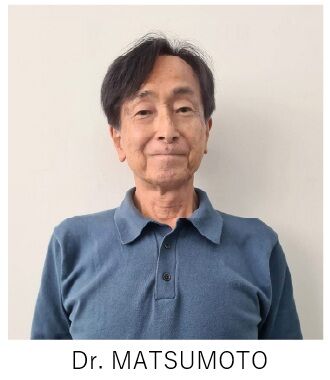
Dr. MATSUMOTO Hiroshi of Accelerator Division V received the 22nd PASJ Award for Distinguished Services. He was highly recognized for his long-term contributions to the accelerator field and his efforts in training young scientists.
Since the construction of the KEK 2.5 GeV electron linac for the synchrotron radiation facility in the 1970s, Dr. MATSUMOTO has been involved in the construction of various accelerator facilities, including KEK, J-PARC, and SACLA, as well as the development of high-power radio-frequency (RF) technology for more than half a century. He has made significant contributions to the development of accelerator technology. He has also focused on training young scientists, helping many of them build careers at research institutes and companies.
In addition to receiving the award, he was also recommended for honorary membership in the Particle Accelerator Society of Japan.
 |
■Press Release
(1) Achieving an Interface with Ultrafast Proton Conduction through Self-Assembly
- Expected Applications in Next-Generation Fuel Cells - (August 18)
In water, protons (hydrogen ions) move much faster than other ions. This phenomenon is known as the "Grotthuss mechanism" and has been widely accepted for more than 200 years. In proton-conducting polymer membranes used in fuel cells and other devices, three mechanisms are known to work together in proton transport: the Grotthuss mechanism, the vehicle mechanism, and the interfacial proton-hopping conduction mechanism.
The research group successfully created a unique interface by using the self-assembly of low-molecular-weight liquid crystals to reduce the distance between sulfonate groups at the interface. At this interface, the interfacial proton-hopping conduction mechanism, in which protons hop between neighboring sulfonate groups, is highly activated, resulting in extremely fast proton conduction (3.5 × 10⁻¹ S cm-1). The calculated proton jump time based on the interfacial proton-hopping conduction mechanism showed good agreement with the relaxation times of the rotational and translational motions of water molecules measured by quasi-elastic neutron scattering using the BL02-DNA, Biomolecular Dynamics Spectrometer at J-PARC MLF.
The results are expected to provide a new approach to designing proton-conducting polymer membranes and lead to advances in energy devices such as fuel cells , as well as biosensors.
They also contribute to deepening our understanding of various biological phenomena involving proton conduction.
For more details (in Japanese only), please visit the J-PARC website.
https://j-parc.jp/c/press-release/2026/08/18001865.html
(2) "Molecules" Rearrange Inside a Metal
- Discovery of a New Electronic State Exhibiting Correlated Chemical Bonding, Metallic Conductivity, and Magnetism - (August 24)
Normally, when atoms form molecule-like bonds in a material, electrons become involved in these bonds, leading to a reduction in conductivity and/or disappearance of magnetism. To date, very few materials have been known to exhibit molecular arrangements change with temperature, along with significant changes in electrical conductivity and magnetism.
The research group investigated Li0.5VS2, a layered compound composed of lithium, vanadium, and sulfur, which undergoes two phase transitions at 345 K (72°C) and 140 K (−133°C). They studied changes in atomic arrangements and electronic states at different temperatures using X-ray and neutron diffraction measurements at SPring-8 and the Ibaraki Materials Design Diffractometer (iMATERIA) at J-PARC MLF complemented by electrical resistance and magnetization measurements. They found that vanadium atoms form a uniform triangular lattice at temperatures above 345 K whereas they form zigzag chains with molecule-like bonds below 345 K. Furthermore, at temperatures below 140 K, these bonds are randomly broken, forming dumbbell-shaped dimers. These results revealed that the magnetic properties of Li0.5VS2 exhibit drastic changes in each temperature range while maintaining electrical conductivity.
These findings suggest a new possibility for designing materials in which chemical bonding, electrical conductivity, and magnetism can change concomitantly with temperature. They are also expected to contribute to the development of new sensors and switching materials.
For more details (in Japanese only), please visit the J-PARC website.
https://j-parc.jp/c/press-release/2026/08/24001868.html
(3) Uncovering the Secret Behind the Golden Luster of Nagoya Castle's Golden Shachihoko
- Non-Destructive Analysis Using Negative Muons at J-PARC Reveals Higher Gold Concentrations Near the Surface of the Scales - (August 24)
Some scales from the golden shachihoko (tiger-headed carp ornaments) on the roof of Nagoya Castle's main tower, which was largely destroyed in an air raid in 1945, were recovered and have been carefully preserved to this day. Despite their vivid golden appearance, earlier X-ray fluorescence analyses did not always indicate high gold concentrations, creating a discrepancy between their appearance and the analytical results.
To understand this discrepancy, the research group used the D-Line at J-PARC MLF to analyze the gold concentration as a function of depth in seven scales without damaging them. By adjusting the momentum of negative muons, the group was able to control their stopping depths within the scales, allowing measurements at various depths. The results showed that five of the seven scales had higher gold concentrations closer to the surface.
This suggests that some form of treatment may have been applied in the past to increase the gold concentration near the surface and enhance the golden luster of the shachihoko.
The surfaces of cultural heritage objects can undergo complex changes due to manufacturing processes, repairs, corrosion, fires, and burial conditions.
The negative muon analysis technique used in this study can be applied not only to the golden shachihoko but also to gold and silver objects, coins, jewelry, and historical artifacts with plated or colored surfaces. This technique may also help scientists study historical manufacturing techniques and restoration histories, contributing to archaeology, art history, and cultural heritage science.
For more details (in Japanese only), please visit the J-PARC website.
https://j-parc.jp/c/press-release/2026/08/24001869.html
■The First Science and Technology Workshop between J-PARC and National Institute of Technology (KOSEN), Ibaraki College to Open Up the Future (August 24)
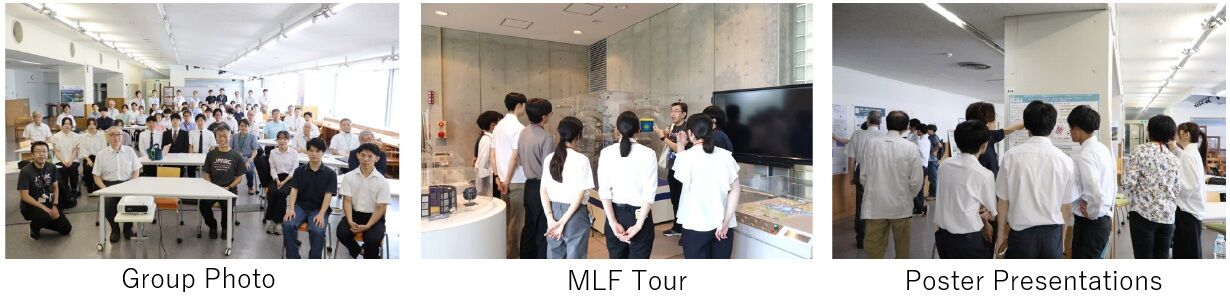
The first "Science and Technology Workshop between J-PARC and Ibaraki College to Open Up the Future" was held, organized by the J-PARC Center, National Institute of Technology (KOSEN), Ibaraki College, and the Comprehensive Research Organization for Science and Society (CROSS).
Approximately 120 people, including students and faculty members from Ibaraki College and J-PARC staff, gathered at AQBRC. The event included nine oral presentations, 23 poster presentations, and a tour of MLF. Active discussions and question-and-answer sessions took place throughout the event.
It was a productive day that raised expectations for future joint studies and stronger collaboration.
 |
■Higashiyamato Mirai Base "Science Forest 2026," Higashiyamato City (August 29)
Higashiyamato City is located in the northern Tama area of Tokyo. It is a green city with Lake Tama surrounded by the Sayama Hills and has a population of just over 80,000. The nonprofit organization Higashiyamato Mirai Base provides opportunities for local children to experience art and science based on the idea that the whole community should work together to support children's futures.
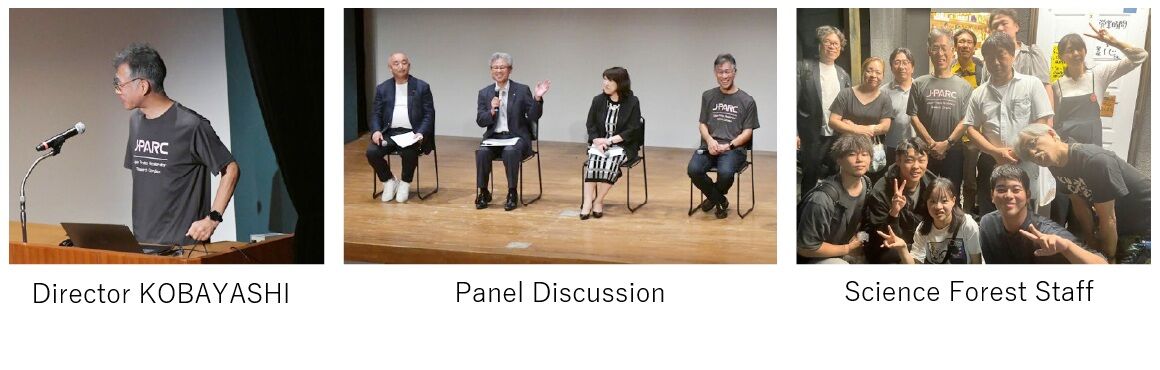
J-PARC Center Director KOBAYASHI Takashi delivered a lecture titled "Invisible Particles Unlock the Mysteries of the Universe" at "Science Forest 2026," organized by Higashiyamato Mirai Base. Many people, mainly families with children, attended the lecture at the Small Hall of Higashiyamato Humming Hall, filling most of the 300 seats. During the lecture, Dr. KOBAYASHI explained various topics in simple terms that even elementary school students could understand. These included the properties of tiny invisible elementary particles, how accelerators speed up protons to nearly the speed of light, the features of J-PARC, and how neutrinos can help us understand the mysteries of the universe.
After the lecture, a discussion was held with Higashiyamato Mayor Ms. WACHI Hitomi, Superintendent of Education Mr. OKADA Hiroshi, and Mr. KINOSHITA Tomio of the Higashiyamato Rotary Club. The participants discussed the importance of giving children more opportunities to experience real science in their local communities. It was a valuable opportunity to think about science education and how local communities can support children's growth.
 |
■J-PARC Sanpo-michi 74: - Raindrops and J-PARC -
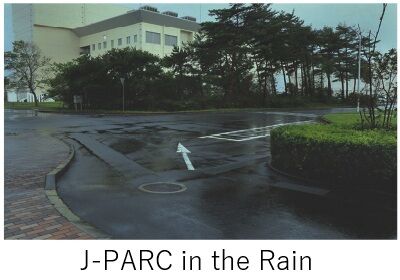
From August to September, it rained almost every day. The sound of rain we hear at night is actually the sound of raindrops hitting roofs and the ground. When raindrops fall into puddles on the road, ripples spread and small splashes appear. In this way, many familiar phenomena around us are caused by particles colliding with something.
J-PARC is a facility where collisions take place on a much larger scale. At J-PARC, large numbers of protons are produced, accelerated to nearly the speed of light, and directed at targets. These collisions produce various particles, including neutrons, muons, neutrinos, and kaons. By using these particles, scientists study the microscopic structures and properties of materials and explore fundamental questions about how the universe works.
 |