


J-PARC News July 2026 (Issue#255)
■Award
2026 Japan Radioisotope Association Encouragement Award
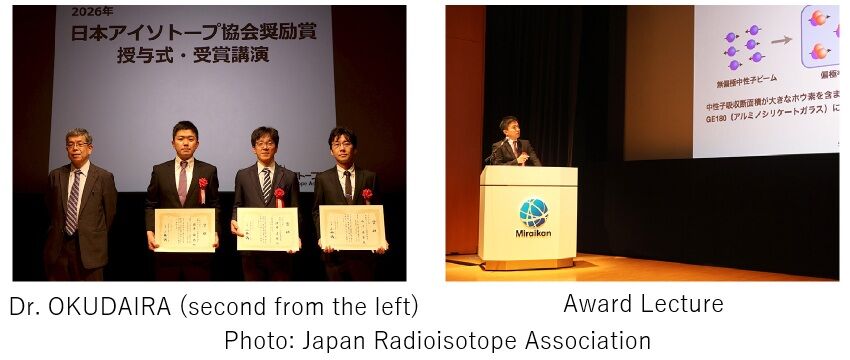
Dr. OKUDAIRA Takuya, Assistant Professor at the Graduate School of Science, Nagoya University, and Visiting Researcher at the Fundamental Technology Development Section, Materials and Life Science Division, J-PARC Center, has received the 2026 Japan Radioisotope Association Encouragement Award.
Dr. OKUDAIRA has been conducting spin-polarized neutron experiments using a neutron polarization device, a 3He spin filter, and successfully developed a high-performance 3He spin filter at J-PARC. The device has been put into practical use at various neutron beamlines at J-PARC. In particular, he applied polarized epithermal neutron beams to fundamental research on time-reversal symmetry violation in neutron absorption reactions by atomic nuclei. Experiments at J-PARC MLF BL04 "ANNRI" revealed that the gamma rays emitted after atomic nuclei absorb polarized epithermal neutrons exhibit an angular distribution. In addition, at BL22 "RADEN," he successfully measured the spin dependence of the cross section between polarized nuclei and polarized epithermal neutrons by polarizing a 139La nuclear target using a superconducting magnet and a dilution refrigerator.
By comparing these results with nuclear theory models, he demonstrated that time-reversal symmetry violation can be extremely strongly enhanced in the neutron absorption reaction of 139La.
The award ceremony was held on July 10 at the National Museum of Emerging Science and Innovation (Miraikan).
 |
■Press Release
(1) - Establishing an Important Foundation for the Development of Novel Magnetic Memory - (June 19)
Atoms in materials have tiny magnetic properties called magnetic moments, which can be thought of as tiny magnets. In helical magnets, the direction of neighboring magnetic moments gradually rotates, forming a helical magnetic structure throughout the material.
The way the helix twists, known as chirality (right-handed or left-handed), has been suggested to be controllable using electric currents and magnetic fields. However, there had been no clear experimental evidence that this chirality could actually be controlled.
This achievement is expected to provide an important foundation for the development of next-generation magnetic memory using helical magnetic materials.
For more details (in Japanese only), please visit the J-PARC website.
https://j-parc.jp/c/press-release/2026/06/19001833.html
(2) Establishing a New Design Guideline for Topological Magnetic Materials
- Discovery of a Homologous Series of Square-Lattice Materials with Dirac Electrons - (July 2)
Topological quantum materials have electronic states protected by topology, in addition to quantum properties such as magnetism and superconductivity. Because these electronic states are highly stable against external disturbances, topological quantum materials are expected to be used in next-generation spintronics and quantum computing. However, unlike layered oxides such as high-temperature superconductors, there has been no established guideline for controlling the properties of these materials by changing the number of layers.
The research group has, for the first time, realized a homologous series of square-lattice magnetic materials with topological electronic states, in which the number of layers can be controlled. Neutron scattering experiments using the JRR-3 research reactor and BL18 "SENJU" at the J-PARC MLF, together with theoretical calculations and high-magnetic-field measurements, showed that both the magnetic properties and topological electronic states can be controlled by changing the number of layers.
This achievement is expected to accelerate the development of new materials for next-generation quantum technologies and lead to the discovery of new quantum phenomena and innovative quantum functions.
For more details (in Japanese only), please visit the J-PARC website.
https://j-parc.jp/c/press-release/2026/06/19001833.html
■11 Junior and Senior High School Students Conduct Beam Experiments J-PARC Muon Facility (June 20-21)
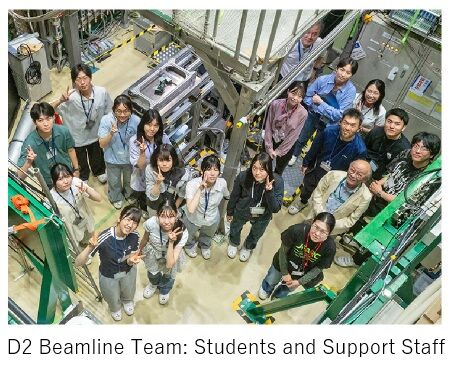
With support from Accel Kitchen, 11 junior and senior high school students conducted muon beam experiments in the Muon D1 area of the MLF. This was the second time that junior and senior high school students had conducted beam experiments at J-PARC, following last year's program. The program was expanded this year, with more participants and an increased number of research topics than last year.
Accel Kitchen has provided junior and senior high school students with simple radiation detectors and supported more than 300 students in conducting radiation and cosmic-ray observations at home. For this program, the organization invited proposals for muon beam experiments, and five projects involving 11 students were selected for experiments at J-PARC. The students will now analyze the data they obtained and plan to present their findings at academic conferences and in research papers.
For more details (in Japanese only), please visit the J-PARC website.
https://j-parc.jp/c/press-release/2026/07/03001838.html
 |
■FY2026 Neutron Industrial Application Report Meeting Held (July 16-17, AKIHABARA Convention Hall and Online)
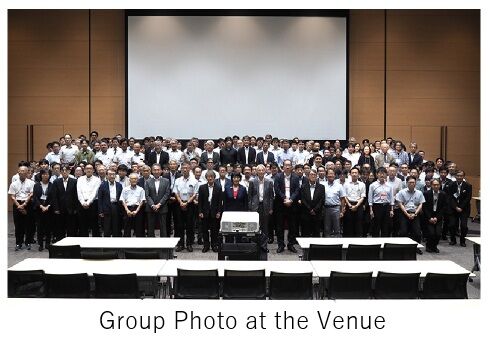
The meeting focuses on introducing cutting-edge measurement technologies and research results using neutrons and muons to meet the needs of industry, and on matching these technologies with what people in industry want to see. The number of participants has gradually increased each year, and this year, 284 people attended the meeting in person and 149 joined online.
As special lectures, on July 16, Mr. SHIMAZU Takashi, President and Chief Research Officer (CRO) of Toyota Central R&D Labs., Inc., gave a lecture titled "Manufacturing Supported by Quantum Beams - 60 Years of Industrial Applications in the Toyota Group."
On July 17, Dr. ORIMO Shin-ichi, Director of the Advanced Institute for Materials Science and Professor at the Institute for Materials Research, Tohoku University, gave a lecture titled "Future Prospects for Hydrogen Science and Technology - From Materials Development to the Use of AI."
The meeting also included general presentations and poster sessions, with active discussions among the participants.
 |
■GSA Science Seminar (July 18-19, Hida City, Gifu Prefecture)
GSA (Geospace Adventure) is an event that offers participants the opportunity to explore the former Kamioka Mine and visit research facilities such as Super-Kamiokande.
Approximately 800 visitors entered the actual mine tunnels, where they stood above the huge water tank of Super-Kamiokande at the deepest point of the tunnel and learned about the neutrinos detected there and their relationship with J-PARC.
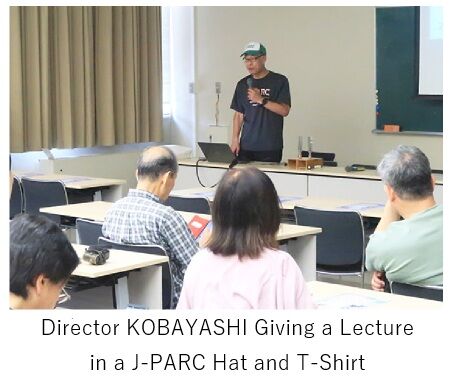
On July 18, a seminar commemorating the 30th GSA event was held under the title "Telling the Story of Science - What Is Being Studied in One of the World's Largest Underground Experiments?" The speakers were Dr. KOBAYASHI Takashi, Director of the J-PARC Center Dr. ICHIKAWA Atsuko, Professor at Tohoku University and recipient of the Saruhashi Prize, and Naoki Prize-winning author IYOHARA Shin. The seminar was moderated by science writer Mr. ARAFUNE Yoshitaka. The speakers discussed the appeal and fascination of science, as well as the personal side of researchers.
On July 18 and 19, Dr. KOBAYASHI also gave a lecture titled "The World's Most Powerful Proton Accelerator - Exploring the Origins of the Universe and Matter at J-PARC."
 |
■J-PARC Hello Science "Particle Production Target: Extreme Design Technology" (June 26)
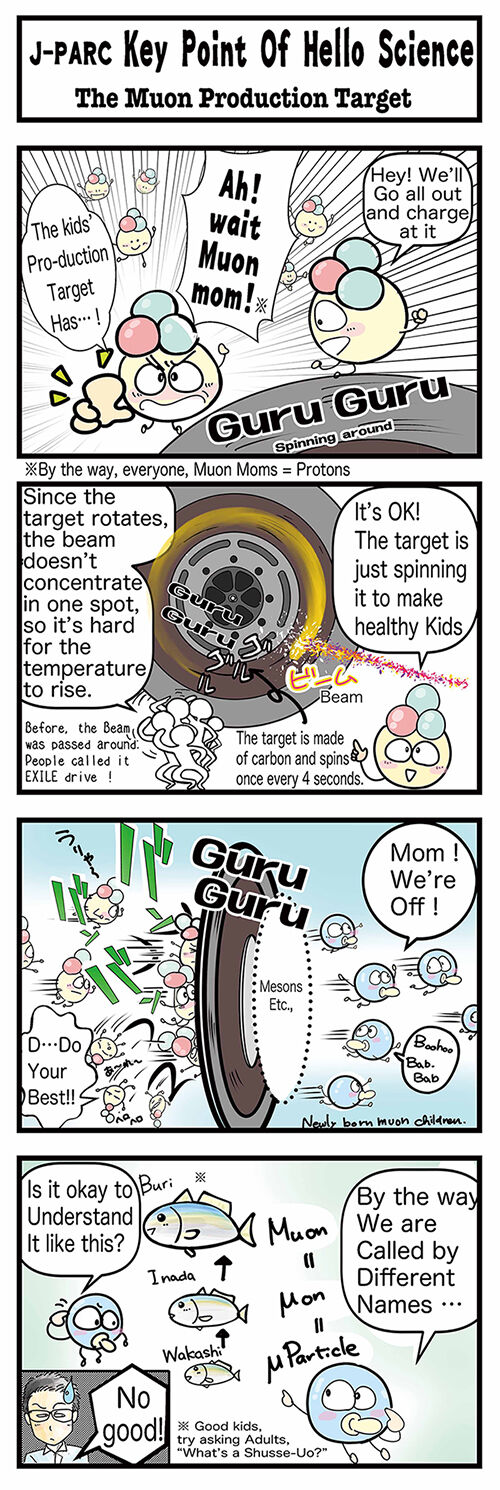
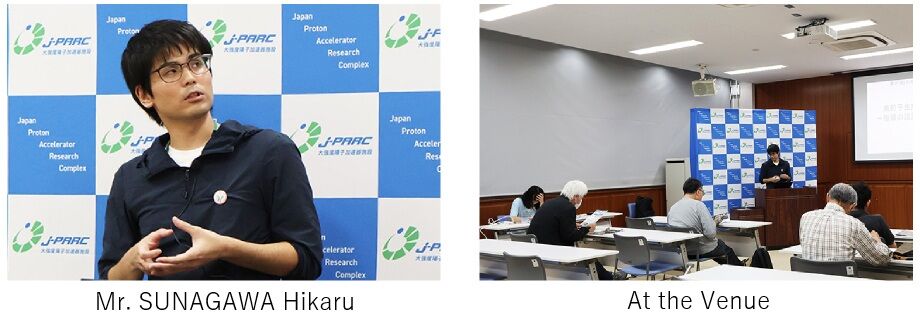
At the seminar, Mr. SUNAGAWA Hikaru of the Materials and Life Science Division introduced the "production target," which is used to produce muons, one of the elementary particles, and supports cutting-edge research at J-PARC.
The target receives the high-intensity proton beam from J-PARC, which has one of the highest beam intensities in the world, and is designed to produce large amounts of muons stably. Various ideas and advanced technologies are used in the target, from selecting suitable materials and installing components to cooling and the rotation mechanism.
Graphite, which has high heat resistance and resistance to thermal shock, is used as the target material. The target is also shaped like a donut and rotated to prevent the high-intensity beam from continuously hitting the same spot, reducing heat concentration and damage.
The lecture also covered the challenges faced during the development of the current production target and the technical approaches used to overcome them. Participants asked a series of questions about material selection and maintenance, showing their strong interest in the production target.
 |
■Outreach
(1) KIPP Nakameguro - Children's Program at Nakameguro Elementary School - (July 4)
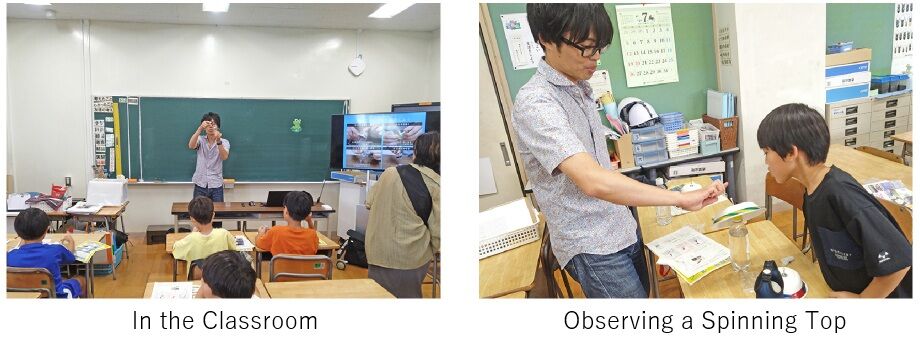
A workshop titled "The World's Smallest? Make a Mysterious Spinning Top and Explore the World of Elementary Particles" was held at the Nakameguro Elementary School Children's Program for 13 students from first to sixth grade. The workshop was led by Dr. OTANI Masashi of the Accelerator Section, who introduced the world of elementary particles using spinning tops.
First, the children learned about J-PARC and elementary particles. They then spun gyroscopes and made their own spinning tops. By changing the center of gravity of their handmade tops, they observed changes in the direction of precession and learned that the motion of precession is similar to the spin property of elementary particles.
 |
(2) Yunago Elementary School, Hitachi City (July 7)
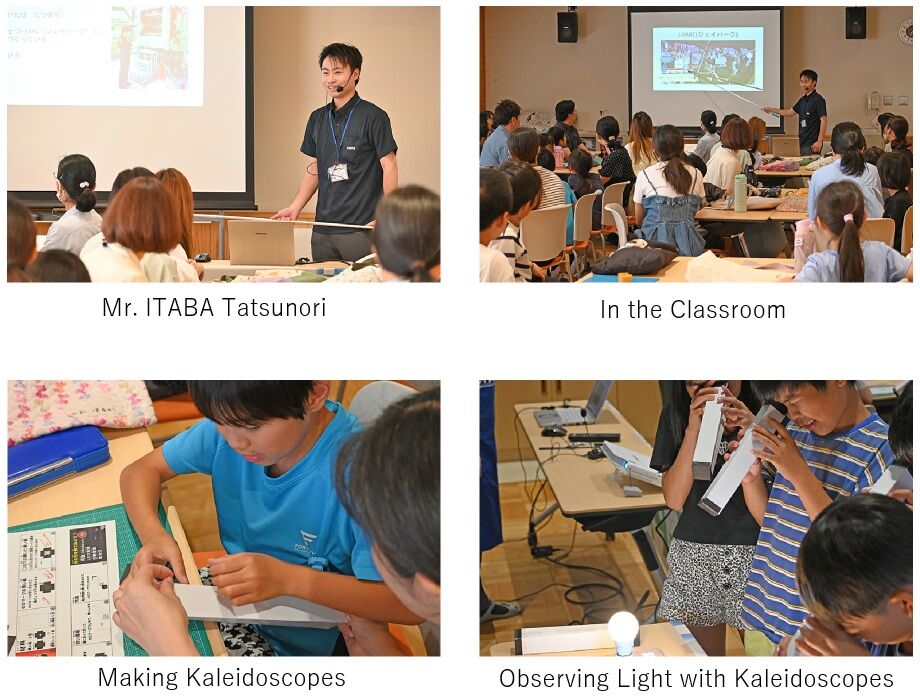
Mr. ITABA Tatsunori of the Particle and Nuclear Physics Division delivered a lecture titled "What Is the Universe Made Of? - Light." The lecture was held at the request of the Hitachi Civic Center as a parent-child learning session for third-grade students at Yunago Elementary School. A total of 30 students and their parents participated.
The participants had fun learning about waves, quantum phenomena, and light together through questions such as, "What properties do waves have?" and "What colors does light have?" During quizzes about waves and light, the children actively shared their ideas, and there were moments when they expressed surprise as they confirmed the answers through experiments.
At the end of the session, the children also made kaleidoscopes using the properties of light, enjoying the craft activity while experiencing the wonders of light.
 |
(3) National Institute of Technology, Kagawa College, Takamatsu Campus (July 8)
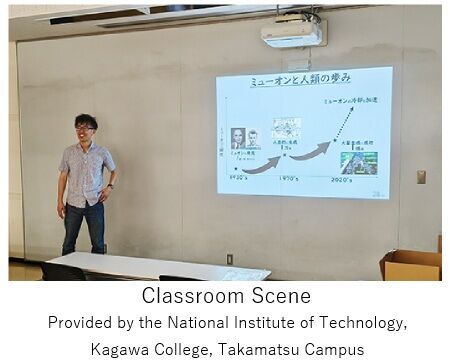
Dr. OTANI Masashi of the Accelerator Division gave a special lecture titled "How Accelerators Work to Explore the Microscopic World" at the Kagawa National Institute of Technology.
In the lecture, he introduced the basic principles of accelerators and examples of their applications, including medical applications. He also discussed the use of muons and the latest developments in accelerator technology and elementary particle research.
During the Q&A session, students asked a wide range of questions, from technical questions such as "How does J-PARC achieve one of the world's highest beam powers?" to career-related questions such as "What kind of work do graduates of technical colleges do at KEK?"
 |
■Muographic Investigation of Ancient Burial Mounds in Tokai: "Mock Excavation" Experience (June 28, Tokai Village Museum)
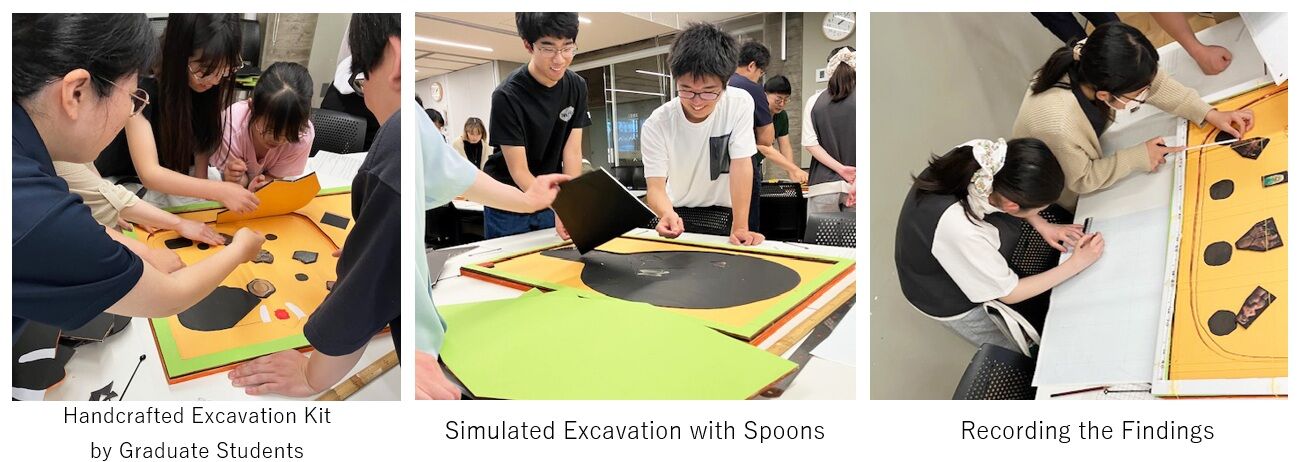
On June 28, although there were concerns that two typhoons might hit the area, the typhoons passed through without major disruption, allowing the second activity to take place. Following a previous session on the basics of archaeological excavation given by Prof. TANAKA of Ibaraki University, the children took part in a "mock" excavation experience this time.
The 11 children were divided into five groups and began their excavation using "archaeological excavation experience kits." The kits were prepared by graduate students from Ibaraki University, who worked until the night before the event. Based on five types of archaeological sites from the Middle and Late Jomon periods, the Yayoi period, the Kofun period, and the Nara and Heian periods, each kit consisted of three layers: a grass-covered surface layer, cultivated soil, and a black soil layer containing artifacts. The panels were designed to fit together like a puzzle. The children carefully "excavated" the soil panels layer by layer using small spoons as miniature shovels, taking care not to move the artifacts.
Afterward, Prof. TANAKA taught the children how to carry out surveying using a method called "yarikata," a type of construction surveying technique. The children then carefully recorded the positions of pottery and other artifacts they had uncovered on graph paper.
Using strings stretched over the model as a guide, they recorded the positions on the graph paper at half scale. They struggled with measuring the distances with a ruler, dividing them in half, and transferring them to the graph paper, but the experience gave them an opportunity to learn both the importance and the difficulty of keeping accurate records.
 |
■J-PARC Sanpo-michi 72: - The Deuteration Laboratory "D-Lab" in the Heat of Summer -
When people think of J-PARC experimental facilities, they may imagine huge accelerators and large experimental facilities. However, J-PARC also has smaller, specialized laboratories that cannot be found anywhere else. One of them is the D-Lab (Deuteration Laboratory), located in the J-PARC Research Building.
Although the room may look like a laboratory at a university or pharmaceutical company, it is where biological samples are prepared for neutron experiments. Unlike X-rays, neutrons are particularly useful for detecting light elements. This makes it possible to distinguish between hydrogen and deuterium in a sample. By replacing hydrogen with deuterium in specific parts of a sample, researchers can study its structure and properties in greater detail.
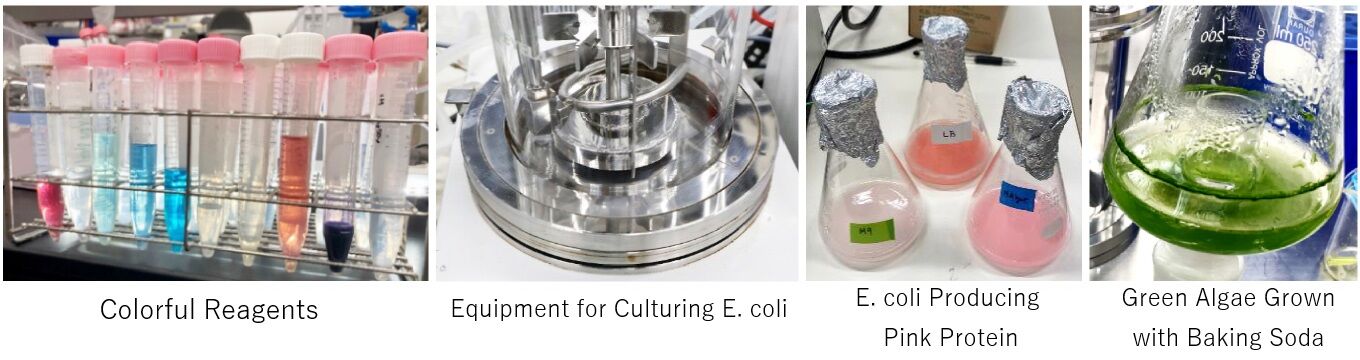
At the D-Lab, genetically modified microorganisms are grown in heavy water to produce deuterated biological samples. After going through various processes, the resulting high-purity, high-quality deuterated samples are brought to neutron beamlines such as "TAIKAN," "DNA,""SENJU," and "iBIX," where they are exposed to high-intensity neutron beams.
The temperature inside the D-Lab is kept at around 20℃ throughout the year to ensure proper sample purification and maintain the performance of the equipment. When you enter the D-Lab from outside, it feels almost like stepping into a limestone cave. While we cannot share the cool air with you directly, we hope that the photo showing the colorful reagents lined up in the laboratory will help you feel a little cooler.
 |